
The complete guide
How to Choose a Silk Bonnet That Actually Fits and Lasts
The problem with waking up to tangled hair
You go to bed with your hair looking fine. You wake up and it has turned into a bird's nest on one side. If you have long hair, curls, coils, or a style you spent real time on, this is the daily frustration that sends people looking for a bonnet in the first place.
The cause is friction. A cotton pillowcase has a textured surface at the fiber level. Every time you shift position, your hair drags across it. Over the course of a night, with maybe twenty or thirty position changes, that adds up to a lot of pulling and rubbing. Cotton also happens to be very good at absorbing, which is the whole reason we make towels out of it.
Silk behaves differently. The fibers are long and smooth, and the woven surface is slick. Hair slides over it instead of catching. Wrapping your hair inside a silk cap means it is sitting against that smooth surface for the whole night, not just for the few hours your head happens to be lined up with the pillow.
What 22 momme actually tells you
Momme, pronounced "mummy," is the unit that describes how heavy a silk fabric is. It comes from the weight in pounds of a roll of silk at a set size. You will see silk bedding and accessories sold anywhere from 12 momme up to 30 momme or so.
Low momme silks, say 12 to 16, are light and translucent. They feel delicate, they are cheaper, and they wear through faster at the stress points. High momme silks, 25 and above, feel thick and luxurious but can also feel warm and cost considerably more.
Twenty-two momme sits in the middle and is the most common choice for sleep products for good reason. It is dense enough that the fabric has real body, drapes properly over the curve of your head, and holds up to repeated washing. It is still fine enough to breathe. If you are comparing options for the best 22 momme silk bonnet, you are shopping in the range most people settle on after trying a few.
Why both sides matter
Here is the thing that catches a lot of shoppers out. Plenty of bonnets advertised as silk are only silk on the outside. The inside, the part that actually touches your hair all night, is often a polyester lining. The listing is technically true and completely useless for the thing you bought it for.
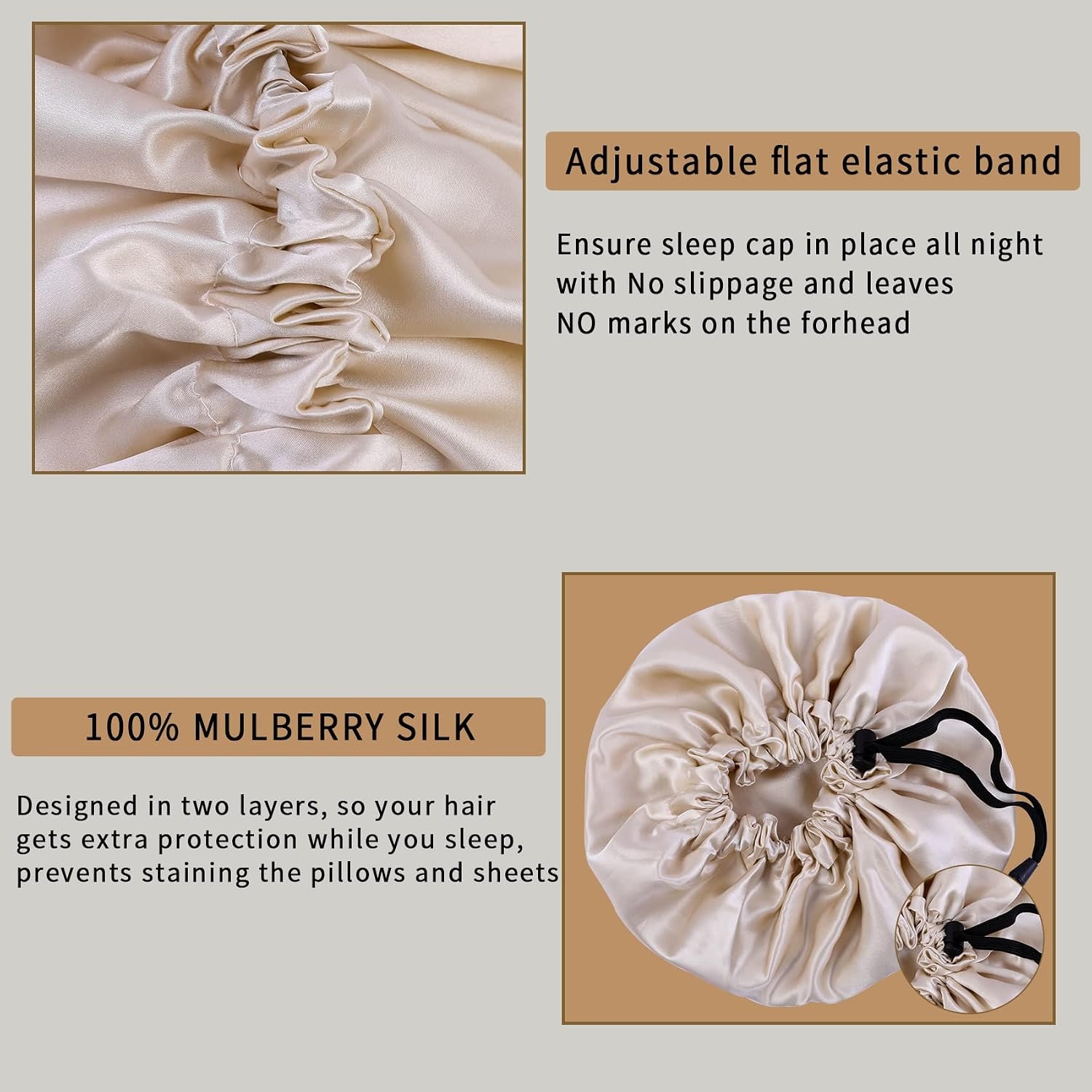
This bonnet uses 100% mulberry silk for both layers. Inner and outer. That means the surface against your hair is the same silk you can see and feel from the outside.
A second benefit falls out of that construction. Because both faces are properly finished, the bonnet is reversible. Turn it inside out and wear the other side. There are no raw seams or exposed stitching on the hidden face, which is also one less thing to rub against your hairline.
Getting the fit right
Fit is the single biggest reason bonnets end up in a drawer. Too tight and you wake with a line across your forehead and a headache. Too loose and it is on the floor by 2am.
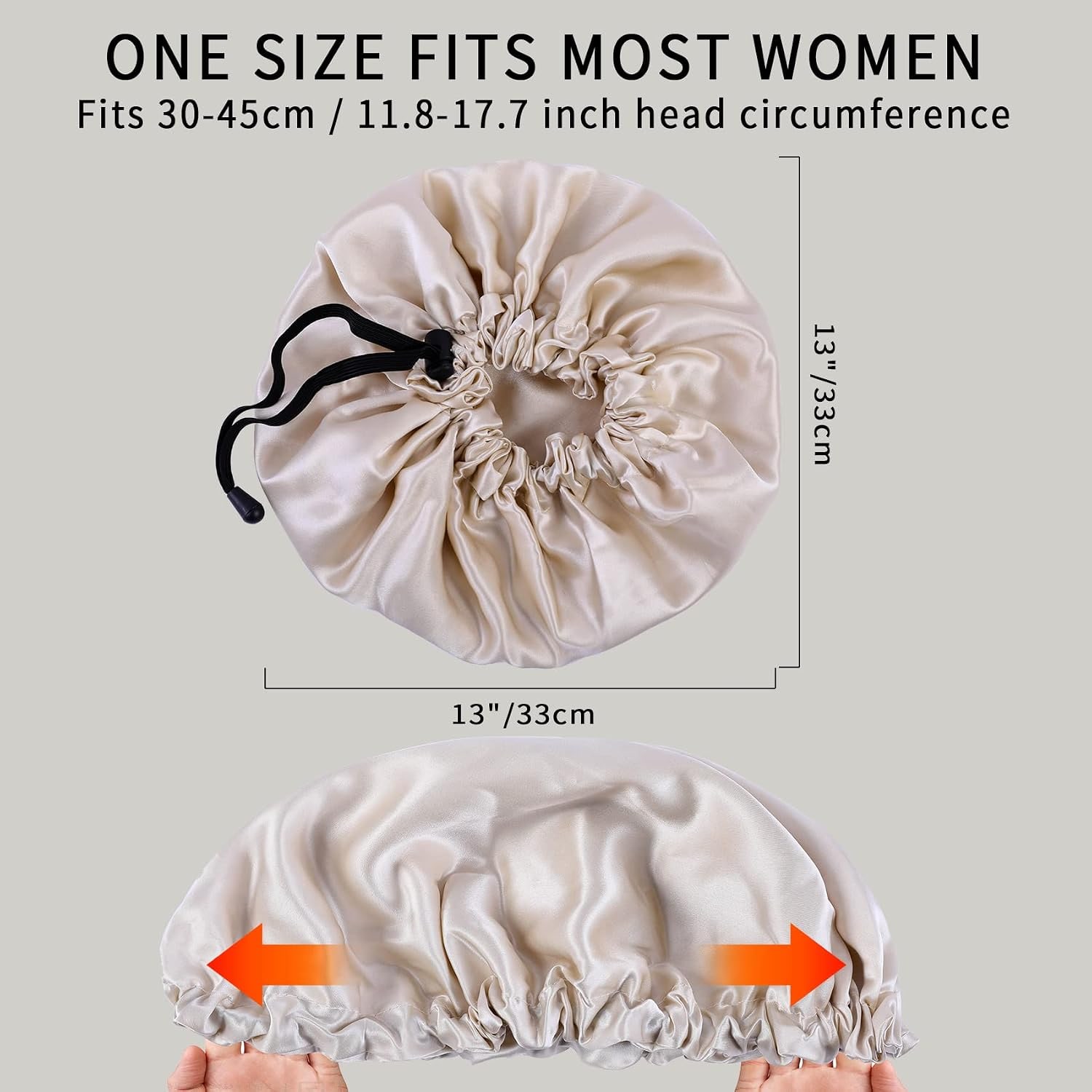
This cap uses an extra-wide elastic band with adjusters on the edge. You pull the tension in or let it out, and the band holds at the setting you choose. It opens out to 17.7 inches of head circumference at full stretch.
To check whether that works for you, take a soft tape measure and run it around your head just above your ears and across the middle of your forehead. That number is your head circumference. If it is comfortably under 17.7 inches, the band will have room to work with. If you wear braids, twists, or rollers under the bonnet, add a little allowance for the extra bulk.
The width of the band is worth a mention on its own. A narrow elastic concentrates all the holding force into a thin strip, and that is what leaves marks. A wide band spreads the same grip over more surface area, so it feels gentler for the same amount of hold. If you have been put off bonnets by that morning forehead crease, a best silk bonnet with wide band is the thing to look for.
Who it suits
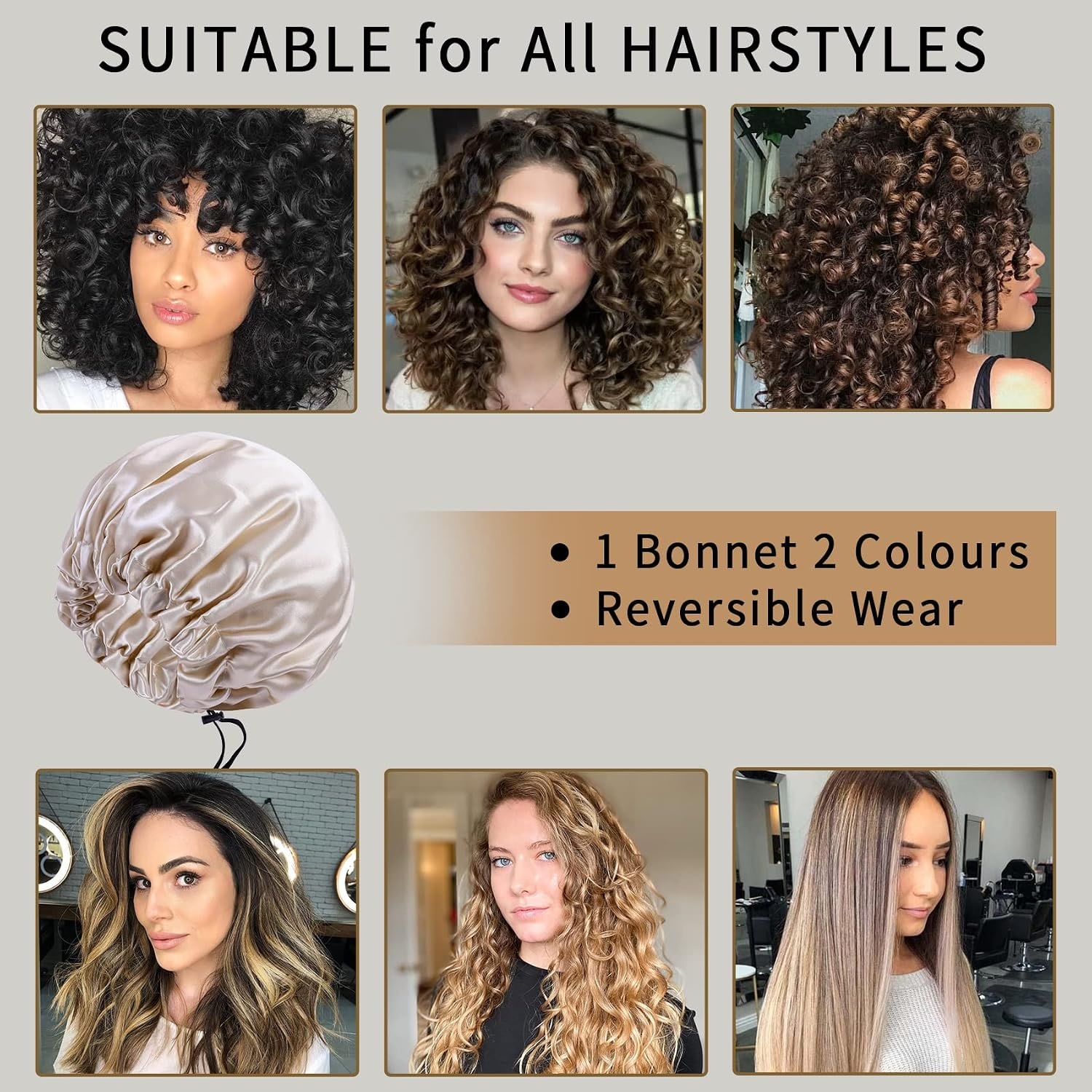
People with long hair tend to notice the difference fastest, simply because there is more hair to tangle. Coiling the length up inside the cap keeps it contained and off the pillow.
Textured hair is the other big group. Curls and coils are more prone to catching on rough surfaces, and a lot of people with natural hair have been wrapping at night for years. The roomy cap shape here matters more than it does for straight hair, because you want volume without crushing the pattern flat.
It also works for anyone with a short cut who simply likes the feel of silk, and for anyone who does their hair in the evening and wants it still intact in the morning. If you use leave-in treatments or an overnight mask, the bonnet keeps the product on your hair rather than on your pillowcase, which saves on laundry.
Beyond the bedroom
A bonnet is not only a night item. Pull it on while you take your makeup off and you keep your hairline clear of cleanser. Wear it in the bath to keep your length dry. Put it on for cleaning, painting, cooking, or anything where you would rather your hair stayed out of the way.
The included scrunchie covers the daytime side of things. Silk ties have the same low-friction advantage as the bonnet, and a wide fabric tie puts less of a crease in your hair than a thin elastic does. Having the two together means you are set for both halves of the day.
Looking after it
Silk is a natural protein fiber, closer in character to hair or wool than to cotton. That means it responds badly to two things, heat and harsh chemicals.
Hand wash in cold water using a mild, neutral detergent. Swirl it gently rather than scrubbing. Rinse until the water runs clear, then press the water out between your palms or inside a towel. Never wring it, as twisting stresses the fibers and distorts the shape.
Reshape the cap and hang it up to dry, somewhere with air movement but out of direct sun. Strong sunlight fades silk over time. Skip the dryer entirely, since heat damages both the silk and the elastic in the band.
Bleach is off the table. So are the enzyme-heavy detergents sold for heavy stains, because those enzymes are designed to break down protein, and silk is a protein. A dedicated delicate wash or a plain gentle soap is all you need.
How often depends on your routine. Every week or two covers most people. If you apply oils or creams before bed, wash more often, otherwise the silk starts to feel coated and loses its slip.
The short version
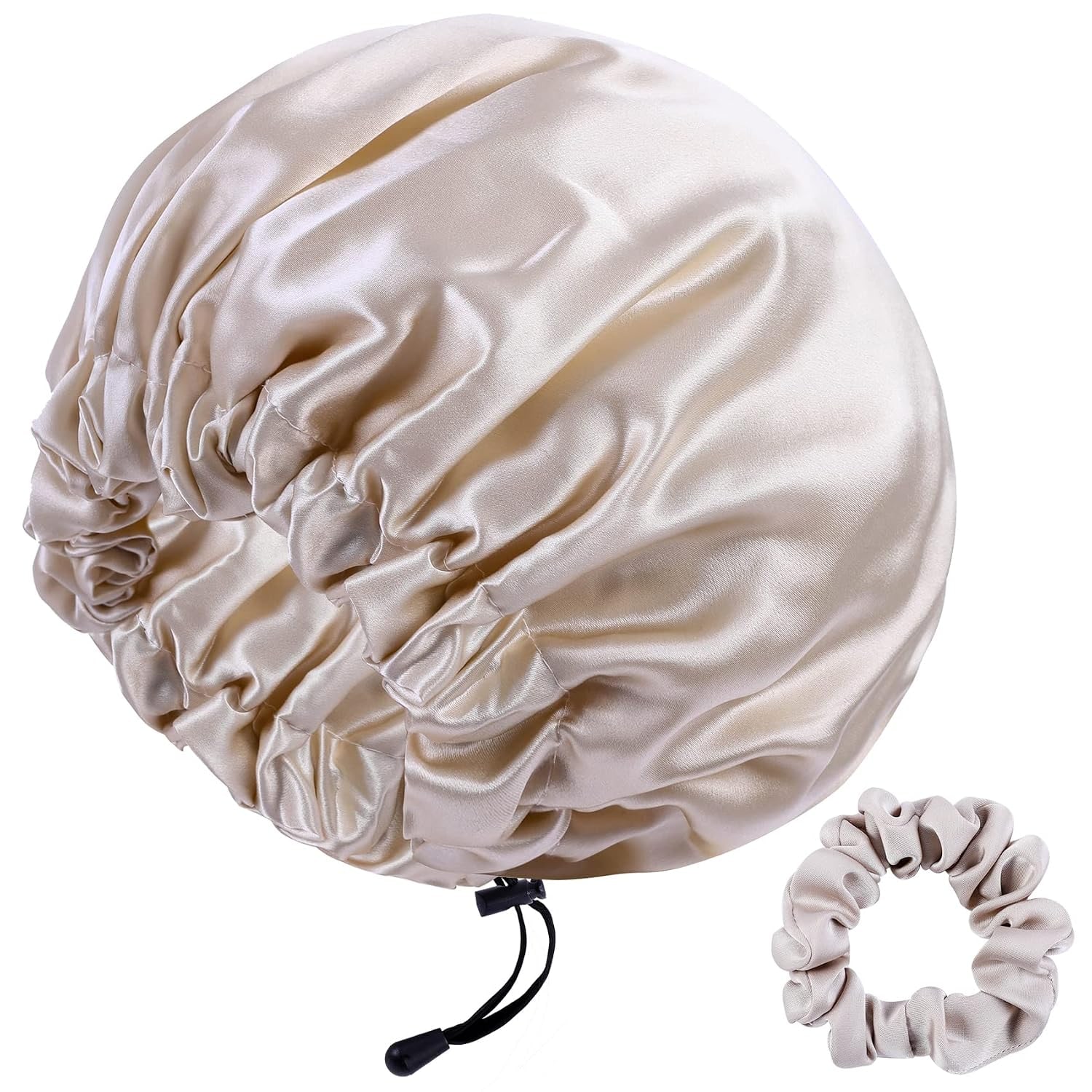
This is a beige sleep bonnet made of 100% mulberry silk on both faces, woven at 22 momme, with an extra-wide adjustable band that fits head sizes up to 17.7 inches. A matching silk scrunchie comes in the box. Care is hand wash cold, no bleach, hang dry.
The two details that separate it from cheaper options are the double-sided silk, which means your hair touches silk rather than a synthetic lining, and the wide adjustable band, which is what makes a bonnet something you actually keep wearing. Measure your head before you order, set the band a little looser than you think you need on the first night, and adjust from there.