

The complete guide
How To Choose And Wear A Large Square Silk Scarf
The problem with most scarves
Plenty of scarves sit in a drawer for years. Not because they are ugly, but because they only do one thing. A narrow printed strip can be knotted at the neck and that is about it. A giant blanket wrap is lovely in January and useless in May. The scarf that actually gets worn tends to be the one that can change shape with the outfit.
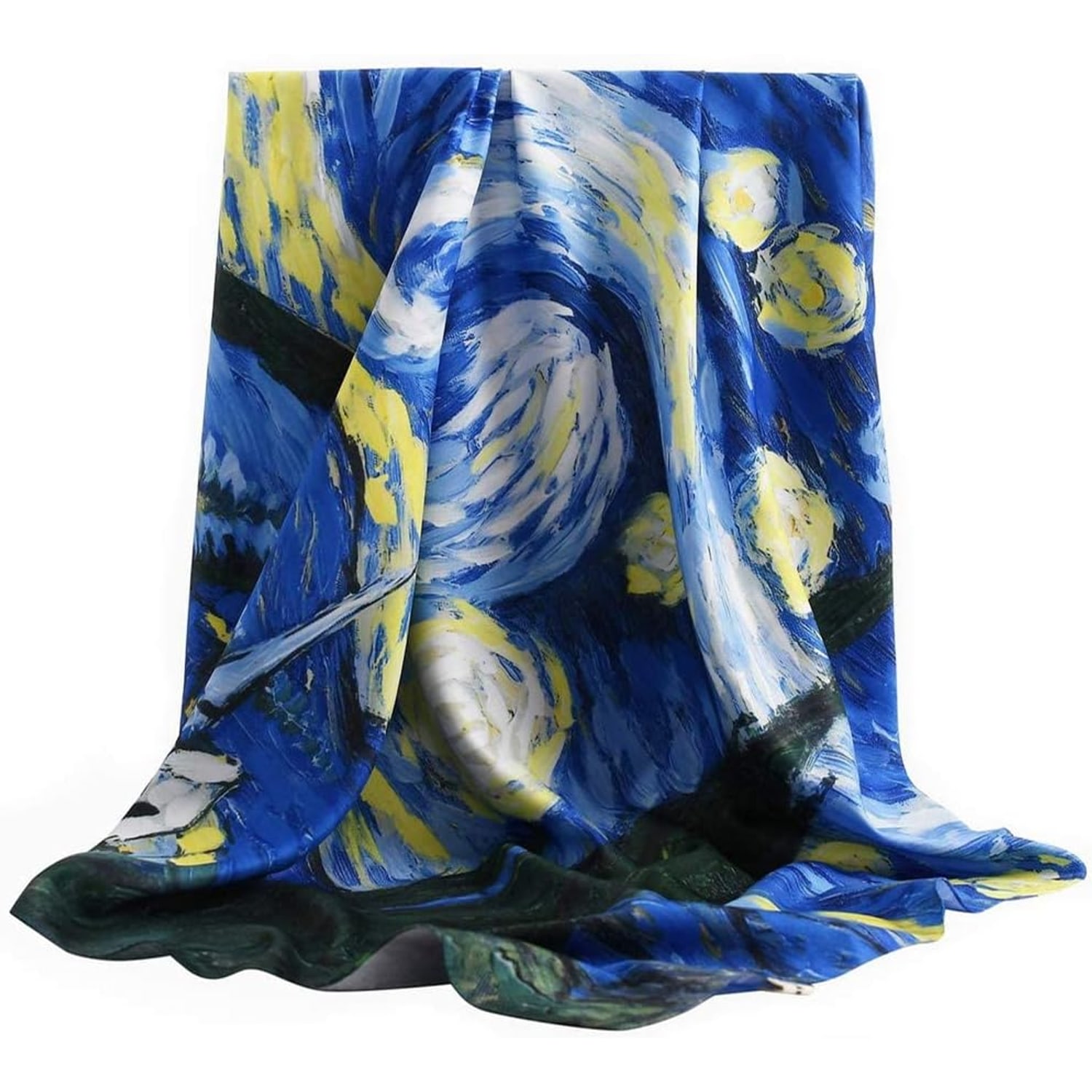
That is the case for a large square. At roughly 35 x 35 inches, this one is big enough to cover a head of hair and small enough to roll into a thin band around a wrist. The same piece of cloth can be a sun cover on a beach walk, a neckerchief with a white shirt, a hair wrap at night, and a tie on a handbag handle. You are not buying one look. You are buying a square of silk and a handful of folds.
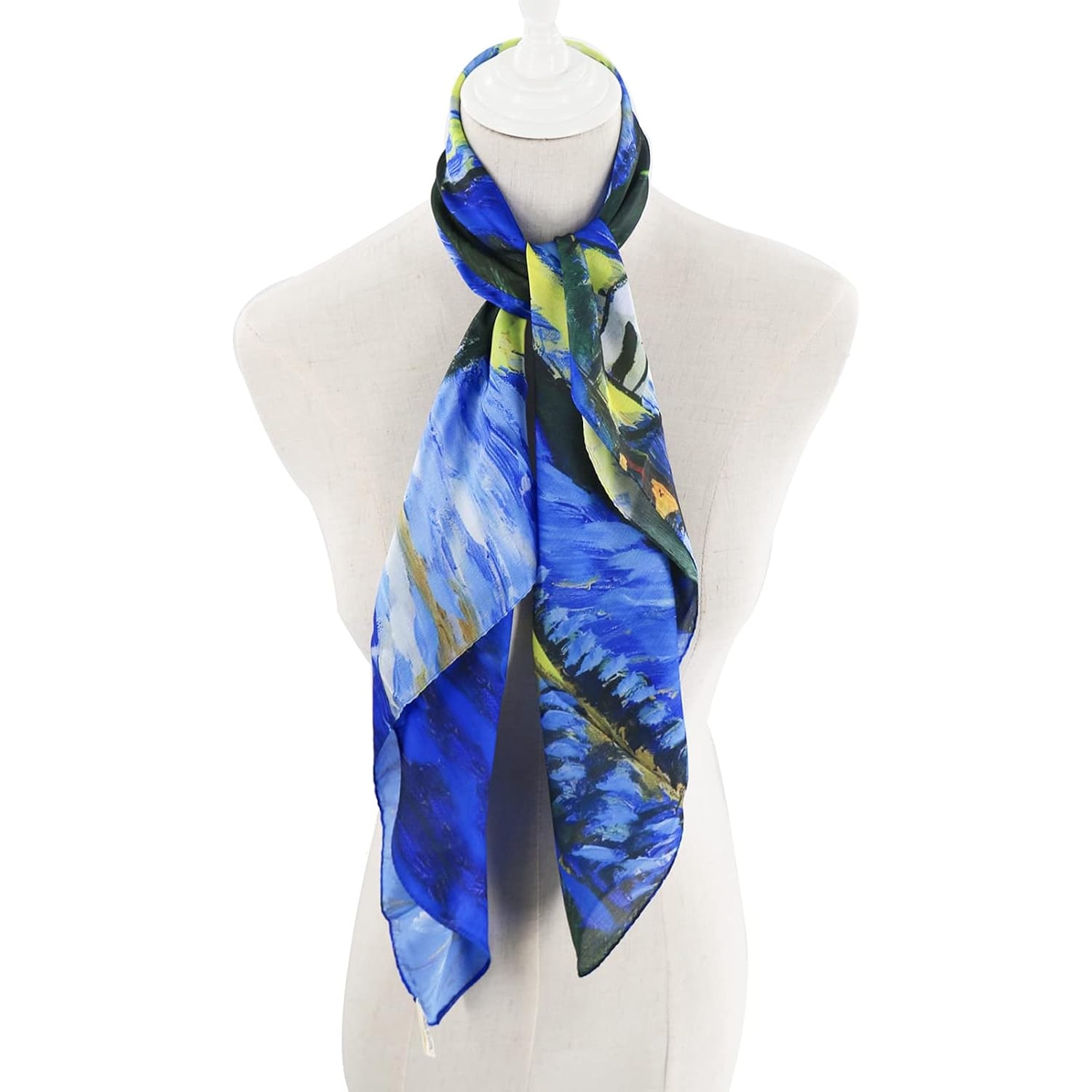
The starry night print does some work here too. Swirling stars across a deep sky read as artwork rather than as a season-specific pattern, so it does not go stale the way a trend print does. It also sits happily next to plain navy, black, gray, cream, and denim, which covers most wardrobes.
What mulberry silk actually is
Silk gets used loosely as a word, so it helps to be specific. Mulberry silk comes from silkworms raised on mulberry leaves under controlled conditions. Those worms spin one long, continuous filament, and because the filament is long and even, the reeled thread is smooth and consistent along its length.
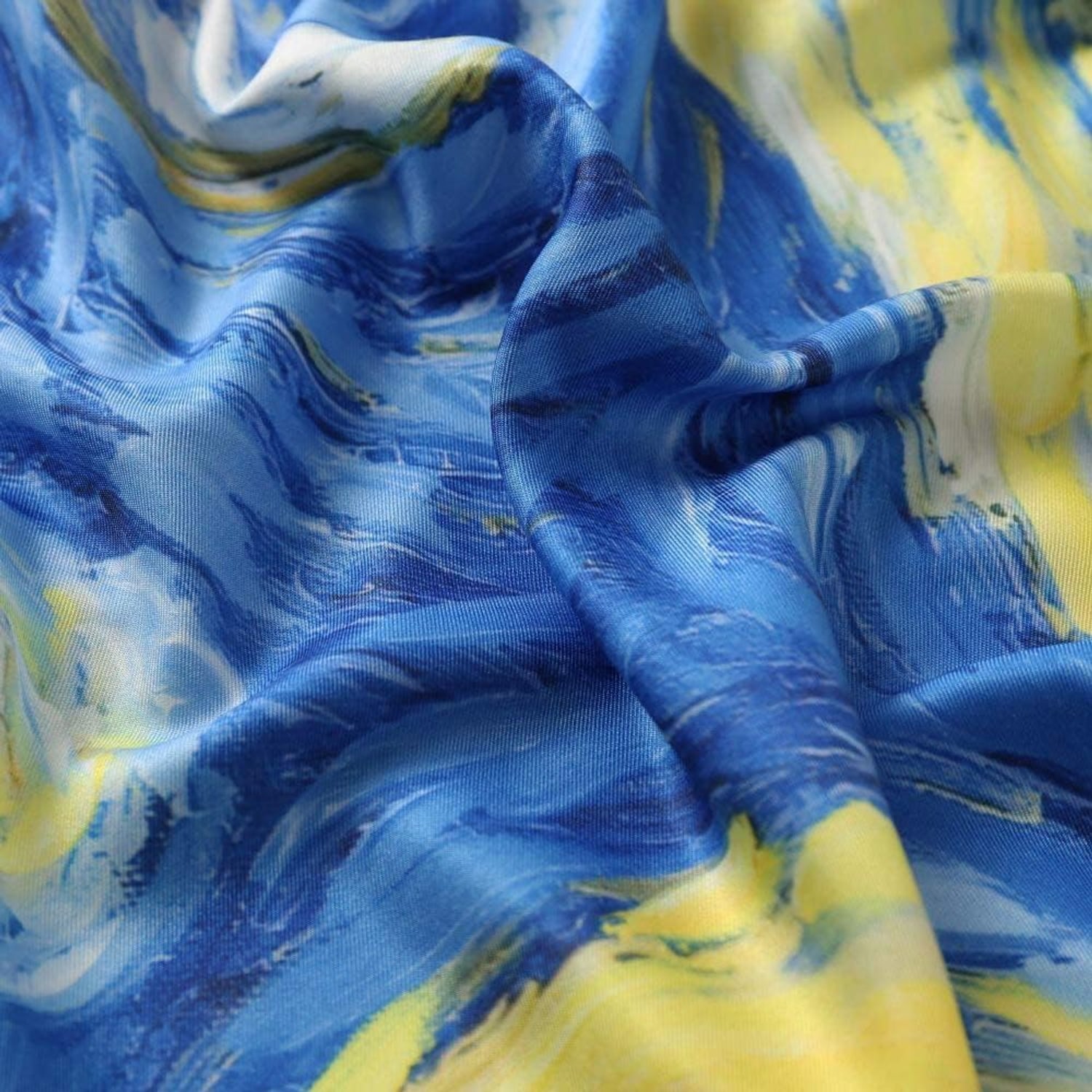
That is the whole reason mulberry silk feels the way it does. Short, broken fibers produce a cloth with tiny ends sticking out, which is what makes some fabrics feel slightly fuzzy against the cheek. Long filaments lie flat. The surface is even, light reflects off it cleanly, and your hand slides across without catching.
There is a practical side to that smoothness. Hair and skin move across silk with less friction than they do across cotton. It is a simple mechanical fact about the fiber, which is why a silk wrap is such a common choice for covering hair overnight or under a hat. We are not going to tell you it does anything more dramatic than that, because that would be a claim about outcomes and this is a scarf.
Silk is also breathable and light. A thin square sits on your neck without trapping heat the way a synthetic scarf can, and it packs down to almost nothing in a bag.
How the print is made
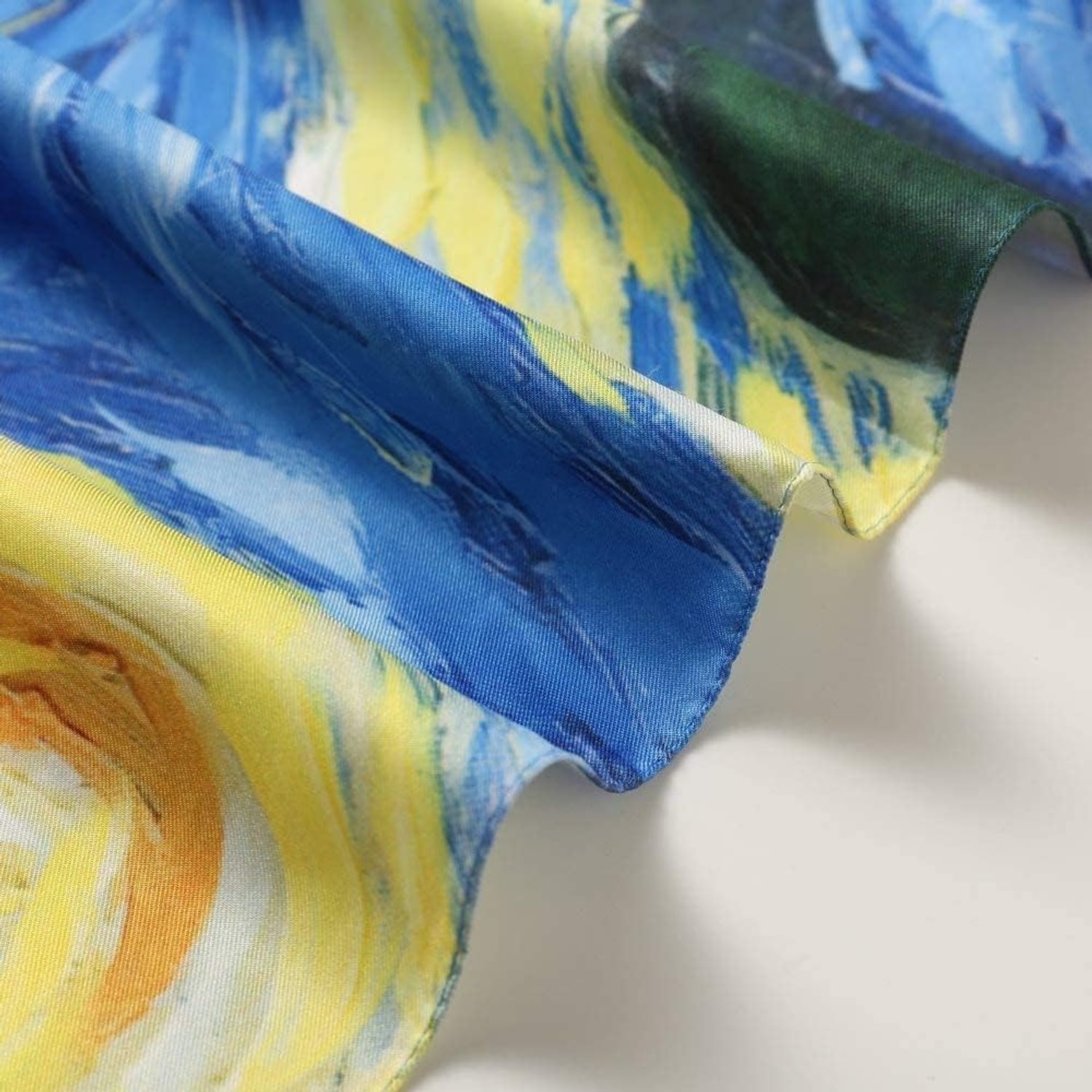
The design on this scarf is applied with digital printing on one side. Digital printing lets fine detail survive, which matters for a night sky with small stars and gradual color shifts across the square. A coarser printing method tends to flatten those gradients into bands.
One-sided printing means the front carries the full-strength image and the reverse is a softer echo of it. This is standard for printed silk squares and it is not a defect. In practice you fold the scarf so the strong side faces out, and nobody ever sees the back.
Because the print sits on the surface of the fiber rather than being woven into it, the fabric keeps its natural weight and drape. It does not feel coated or stiff. The trade-off is that printed silk benefits from a careful first wash, since richly colored prints can release a little surface dye the first time they meet water.
Who it suits
Someone building a small, flexible wardrobe. One good printed square does more than three cheap scarves, and it travels well.
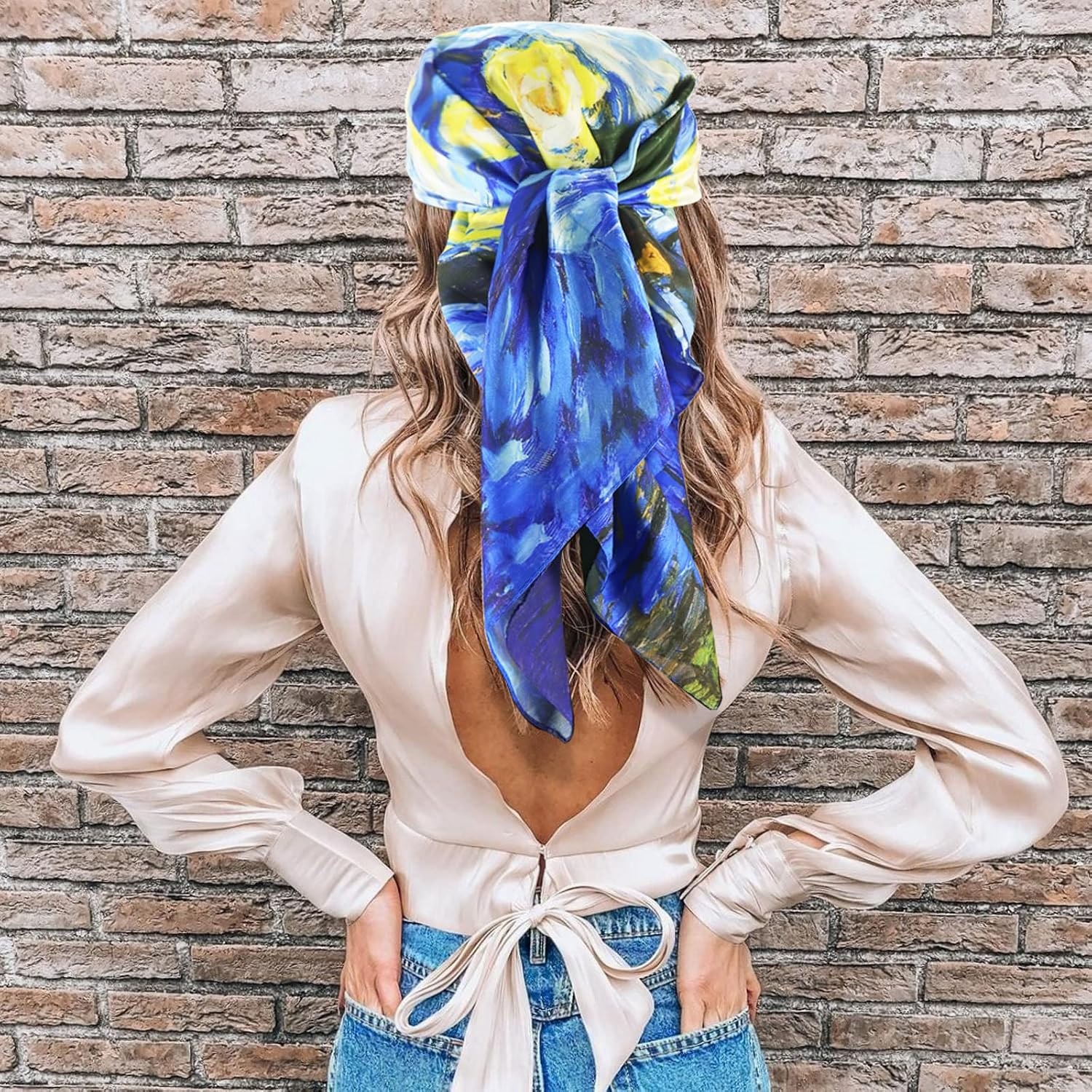
Someone with long or textured hair who wants a wrap for the pillow or for windy days. The 35 inch size is the useful one here. Anything smaller struggles to cover the whole head and still tie off properly.
Someone who needs a reliable gift. There is no size to guess and no fit to worry about, which removes most of the risk from buying for another person. A flat square also posts easily and wraps neatly in tissue.
Someone who likes the idea of an accessory doing real work. On a bright day it goes over the head. On a windy platform it goes around the neck. Clipped to a plain bag it changes the whole look of the bag for nothing.
Who it suits less: anyone who wants genuine winter warmth from a single layer, or anyone who will not hand wash. Silk is not difficult to look after, but it does not survive a hot machine cycle and a dryer.
Ways to fold it
Start with the basic triangle. Fold the square corner to corner, place the long edge across the front of your neck, and tie the two points behind. This is the easiest neck scarf and it uses the full width of the print.
The head wrap is the same triangle turned around. Lay the long edge across your forehead with the point hanging down the back, bring the two side points behind your head, cross them, and bring them forward to knot at the front or tuck them in. Twisting each end before you tie gives silk something to grip.
The band is made by folding the square in half diagonally, then rolling or folding from the long edge up toward the point until you have a strip a couple of inches wide. That strip becomes a headband, a ponytail tie, a wrist wrap, a belt, or a bag handle tie depending on where you put it.
The shoulder drape skips folding altogether. Open the square flat, lay it across the shoulders on the diagonal, and let it sit. It is the fastest way to finish a plain dress or a sleeveless top on a cool evening.
Silk is slippery, so a knot that looks secure can creep loose over hours. Two fixes work. Twist the ends before tying so the fibers lock against each other, or use a tiny flat hair clip hidden underneath. Neither is visible once the scarf is in place.
Looking after it
Hand wash only, in cool water, with a mild detergent made for silk or wool. Swirl the scarf through the water instead of rubbing or scrubbing. Rinse until the water runs clear.
Never wring it. Twisting forces water through the weave under pressure and that is how fabric distorts. Lay the scarf on a clean towel, roll the towel up, and press. Then dry it flat or hang it somewhere shaded. Direct sun fades printed color faster than almost anything else.
Press on the lowest iron setting, ideally on the reverse side or with a thin cloth in between. Steam held a few inches away also works if you prefer not to touch the iron to the silk. A new scarf will usually arrive with packing creases, and a quick pass flattens them out properly.
For storage, roll rather than fold if you have the drawer space, since rolling avoids permanent crease lines. Keep it away from damp and away from rough hooks and zips that can snag a thread. If a thread does pull, ease it back through to the reverse with a fine needle instead of cutting it.
Done this way, a silk square lasts for years. The fiber is stronger than its reputation suggests. What shortens its life is heat, harsh detergent, and machine agitation, and all three are easy to avoid.
The short version
This is a 35 inch square of 100% mulberry silk with a digitally printed starry night design on one side. It is light, smooth, and big enough to work as a head wrap, a neck scarf, a shoulder drape, a hair band, a belt, or a bag tie, depending on how you fold it.
Care is simple but specific. Hand wash in cool water, press the water out in a towel, air dry in the shade, and press on low heat. No machine, no dryer, no bleach.
The maker does not state the net weight, hem finish, or country of manufacture, so we have not guessed at those. What is confirmed is the fiber, the square format, the printed design, and the hand wash requirement. If you want one accessory that changes shape with whatever you are wearing, a large square in good silk is hard to beat.