

The complete guide
How to Choose a Silk Sleep Mask That You Will Actually Keep Using
The small problem that costs you an hour of sleep
Most people do not lose sleep in one dramatic chunk. They lose it in slices. A car turns into the driveway and sweeps the ceiling. The clock radio glows a little too brightly. The sun comes up at five in June and the blind does not quite reach the frame. None of it is enough to make you sit up, but all of it is enough to pull you out of the deeper stages and leave you foggy at eight in the morning.
Light is one of the strongest signals your body uses to decide whether it is time to be awake. You can spend a lot of money on blackout curtains and still get a line of daylight down one side of the window. A sleep mask skips all of that. It travels, it costs a fraction of the curtains, and it works in a hotel room, on a plane, in a spare bedroom at your in-laws, and in your own bed at four in the afternoon when you are on nights.
The catch is that a lot of sleep masks are unpleasant to wear. Stiff foam. A strap with a plastic buckle that lands exactly where your head meets the pillow. Hook and loop fastening that eats your hair. Those masks get used twice and then live in a drawer. The mask that helps is the one you forget you put on.
What momme actually tells you
If you have shopped for silk before, you have seen the word momme and probably skipped past it. It is worth two minutes.
Momme measures how much a set area of silk weighs. The higher the number, the denser the fabric. Thin silk scarves sit around 8 to 12 momme. Good silk bedding is usually in the high teens to low twenties. This mask is 19 momme, which puts it in that useful middle band where the fabric has enough body to feel substantial and hold its shape, but is still light and flexible enough to drape over the shape of your face.
Why does density matter for a mask? Two reasons. First, denser fabric lets through less light. Hold a low momme silk up to a lamp and you will see the glow come through the weave. Second, a denser silk survives washing better. A mask gets washed more often than a pillowcase and it gets stretched every time you put it on, so a fabric with some substance to it lasts longer before it starts to go limp.
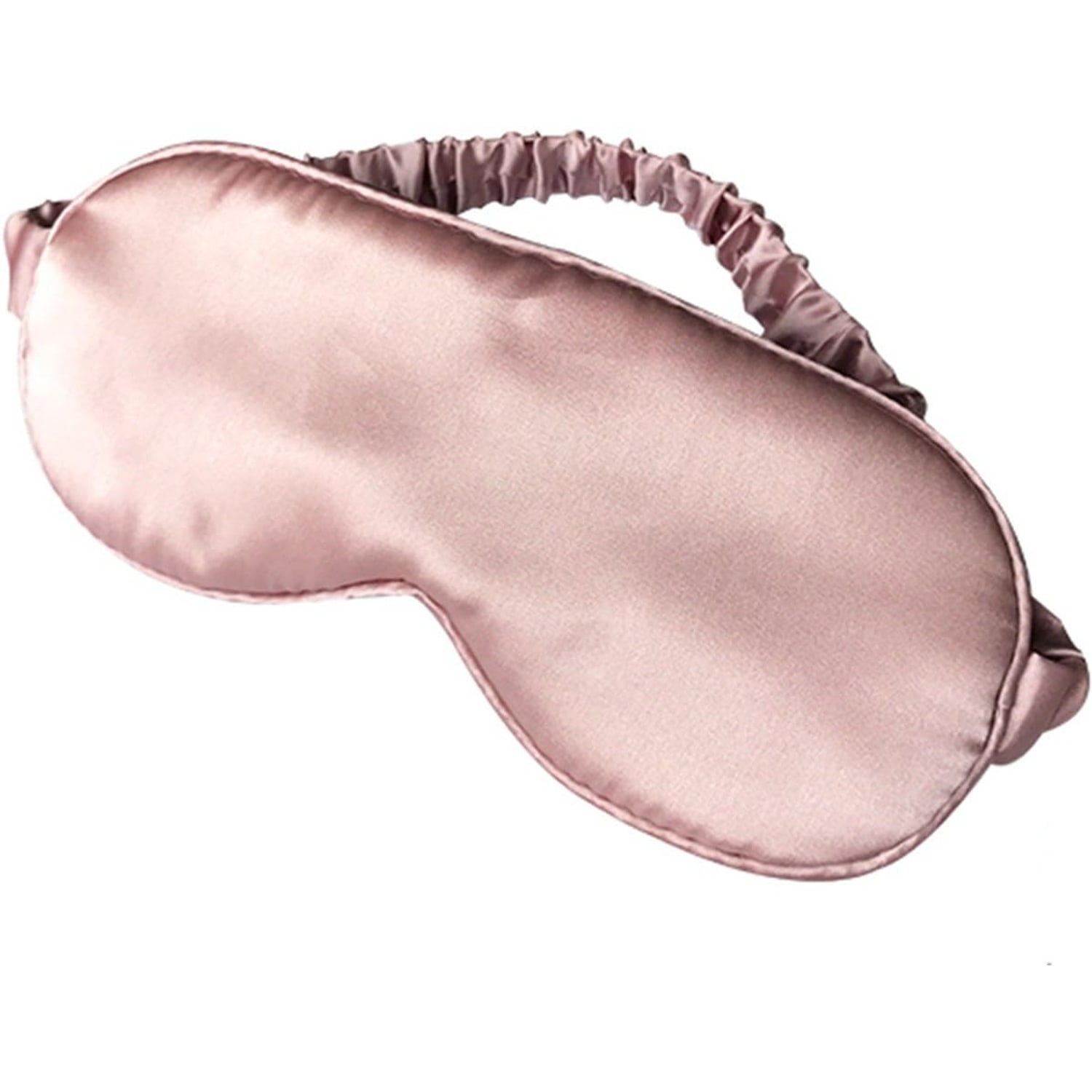
The other thing worth checking is what is inside. Plenty of masks use silk only on the surface and fill the middle with polyester wadding or a slab of foam. That changes the feel completely. It makes the mask warmer, springier, and more likely to stand away from your face. This one uses silk filling between the two silk faces, so the whole thing stays light and conforms rather than bridging.
Flat panel or contoured cup
There are two basic shapes on the market and they suit different people.
A contoured mask has molded cups that arch over the eye sockets, so nothing touches your lashes. People who have had eye surgery, who wear heavy lash extensions, or who simply cannot stand pressure on the eyelids often prefer them. The trade-off is bulk. Contoured masks sit proud of the face, they have more structure in the strap area, and when you roll onto your side they can get levered off center by the pillow.
A flat panel mask, like this one, lies against the face. There is no rigid structure, so it settles into the dip beside the bridge of your nose and the hollow under the brow. That tends to seal light better for a lot of face shapes, and it packs down to nothing. The soft silk also means you are not getting hard pressure anywhere, just light contact spread across the whole area.
If you are a side sleeper, the flat panel usually wins. Nothing to push against, nothing to pop a seal when your head sinks into the pillow. If you genuinely cannot tolerate any contact with your lashes, look at a contoured mask instead and accept the extra bulk. There is no single best sleep mask, only the one that matches how you lie down.
The strap is half the product
This is the part people underestimate. A mask can have beautiful silk and still be miserable because of the band.
Thin elastic cuts in. You feel it as a line of pressure after twenty minutes, and if you sleep on your back you wake with a crease across your head. Hook and loop fasteners are adjustable but they are rough on hair, and over time they fray whatever they touch. Buckles are precise but they are a hard lump exactly where you do not want one.
A flat elastic band around 0.4 inches wide, which is what this mask uses, is the sensible middle ground. The extra width spreads the same tension across more skin, so you feel it less. There is no hardware to press into your skull. And because the band is smooth and flat, long hair slides through it instead of wrapping around it, which is the difference between taking your mask off in the morning and untangling your mask from your hair in the morning.
The one thing to know is that a plain elastic band stretches to fit rather than adjusting by a slider. For the vast majority of heads that is fine. If you have a very large or very small head, it is worth knowing before you buy.
Who this suits
Anyone woken by early light will get something out of it. So will anyone sharing a room with a different schedule, where one person is reading and the other is trying to sleep.
Travelers are the obvious group. Planes are badly lit, hotel curtains never quite close, and a mask that weighs a third of an ounce and folds flat costs you nothing in luggage. Shift workers are the other big one, since sleeping through the middle of a bright day is mostly a light problem.
It also works as a gift, which is harder than it sounds. There is no size to get wrong, it suits almost anyone, and it does not demand that the recipient already be into a particular thing.
Who it does not suit: anyone who needs zero contact with the eyelids, and anyone who wants a weighted mask for the pressure sensation. Those are different products with different goals.
Taking care of it
Silk is a protein fiber, closer to hair than to cotton, and it responds to the same basic kindness. Cool water, mild detergent, no bleach, no wringing.
Hand washing is the gentlest route and it takes about four minutes. Swirl it in cool water with a small amount of gentle soap, rinse until the water runs clear, then press the water out between the palms of your hands or in a towel. Do not twist it. Lay it flat to dry somewhere out of direct sun, because sunlight and heat both weaken silk over time.
If you would rather use the machine, run it on a cold delicate cycle inside a mesh laundry bag, on its own. The bag matters. A zipper or a hook from another garment can pull a thread in a single wash. Skip the dryer entirely.
Wash it every week or two with regular use, and more often if you apply products to your face before bed. If it needs smoothing afterward, a cool iron on the reverse side will do it. Keep perfume and hairspray off the silk, since alcohol based sprays can mark dyed fabric.
The short version
Look for silk on both faces and silk inside, not a silk shell over foam. Check the momme, because a 19 momme weave has the body to block light and survive washing while still draping over your face. Pick the flat panel if you sleep on your side or care about packing small, and pick the contoured cup if lash contact is a dealbreaker. Pay attention to the strap, since a flat elastic band is kinder to your head and your hair than a thin cord or a hook and loop closure. Then wash it cool, dry it flat, and it will keep doing its quiet job for a long time.