
The complete guide
How To Choose Silk Pillowcases, A Practical Buyer's Guide
The pillowcase nobody thinks about
You spend about a third of your life with your face pressed into a pillowcase. For most people that surface is cotton, chosen by whoever assembled the sheet set, and never considered again. Cotton is fine. It is also grabby. Run a fingertip across a cotton case and you can feel it catch. Do that for eight hours a night with your cheek and your hair and you understand why so many people wake up with sleep creases and a nest of tangles.
Silk is the obvious alternative, and it has a reputation problem. People assume it is fragile, that it needs dry cleaning, that it is too precious for a bed that gets actually slept in. None of that holds up for a well-made 19 momme case. It washes in a machine, it lasts for years, and it does the one job you want from a pillowcase, which is to let your skin and hair move over it instead of dragging.
This guide walks through what the numbers on a silk pillowcase label actually mean, how to pick a size that fits, and how to wash the thing without ruining it.
What momme actually tells you
Momme is the measure of silk fabric weight. The word comes from Japanese silk trading and the number refers to the weight in pounds of a piece of silk measuring 100 yards by 45 inches. In practice you only need to know the rough bands.
Below 16 momme, silk bedding starts to feel thin. It will be cheaper, it will drape beautifully, and it will not hold up to the friction of a head moving across it night after night. Somewhere around 19 to 22 momme is where most quality bedding sits. At 19 momme you get a fabric with genuine body, one that feels substantial in the hand and survives weekly washing, while staying light and breathable enough that it never feels heavy. Push above 25 momme and the price climbs faster than the benefit for a pillowcase.
So when you see 19 momme on a label, read it as the sensible middle. It is the weight chosen by people who want the silk to still be there in three years.
Grade 6A and why filament length matters
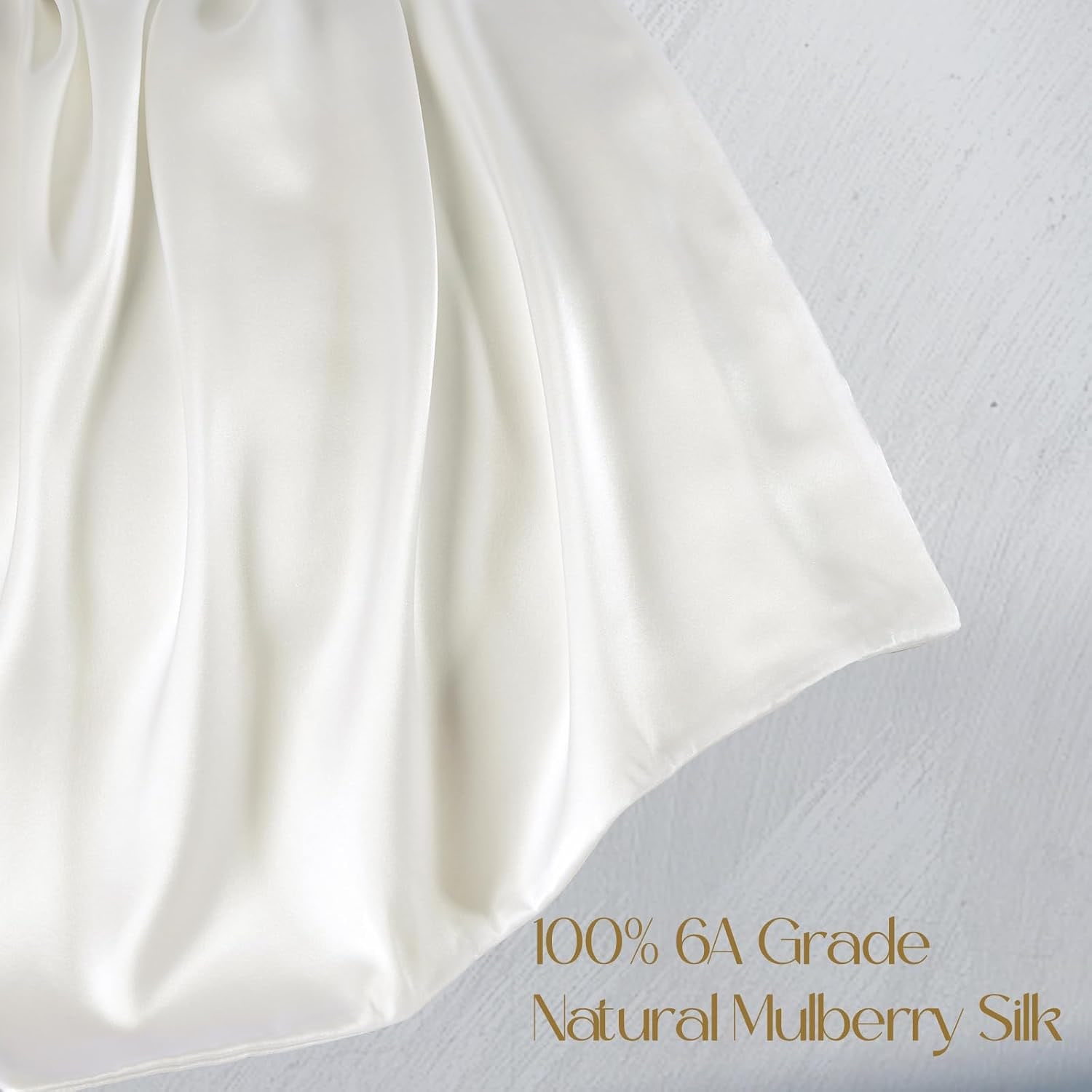
The other number you will see is a grade, usually written as something between 2A and 6A. This refers to the raw silk filament rather than the finished cloth. Longer, more even filaments produce fabric with fewer joins, a smoother surface and better tensile strength. Grade 6A is the top of that common scale.
The practical difference shows up over time. Lower-grade silk, woven from shorter filaments, tends to pill and develop a slightly fuzzy surface after repeated washing. Higher grades hold their smoothness. You will not necessarily feel the difference on night one. You will feel it on night two hundred.
Thread count sits alongside both of these. At 600, the weave on these cases is dense and tightly packed, which is typical of a good charmeuse. Thread count on its own is a weak signal for silk, though, because the yarns are so fine. Always read it together with momme rather than instead of it.
Both sides silk, and why that is worth checking
Here is a shortcut that separates serious silk pillowcases from the ones padding out a bargain listing. Check whether both faces are silk.
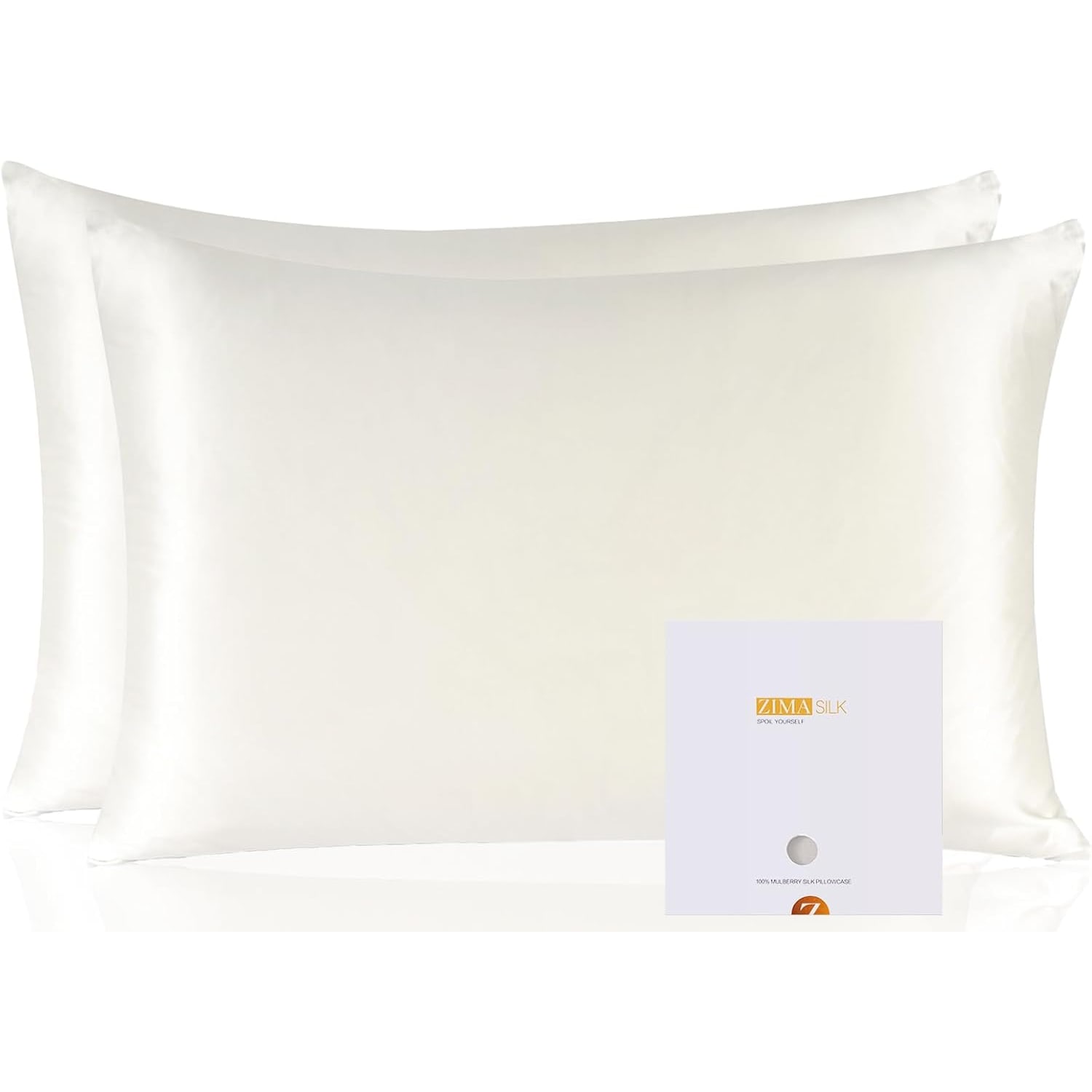
A surprising number of cases are silk on one side only, backed with cotton or polyester to cut the cost. They are not necessarily bad products, but they come with a catch. You have to keep the silk side up. Flip the pillow in the middle of the night, which everyone does, and you are suddenly sleeping on the cheap face. These cases are 100% mulberry silk on both sides, so the pillow can go either way and the surface never changes.
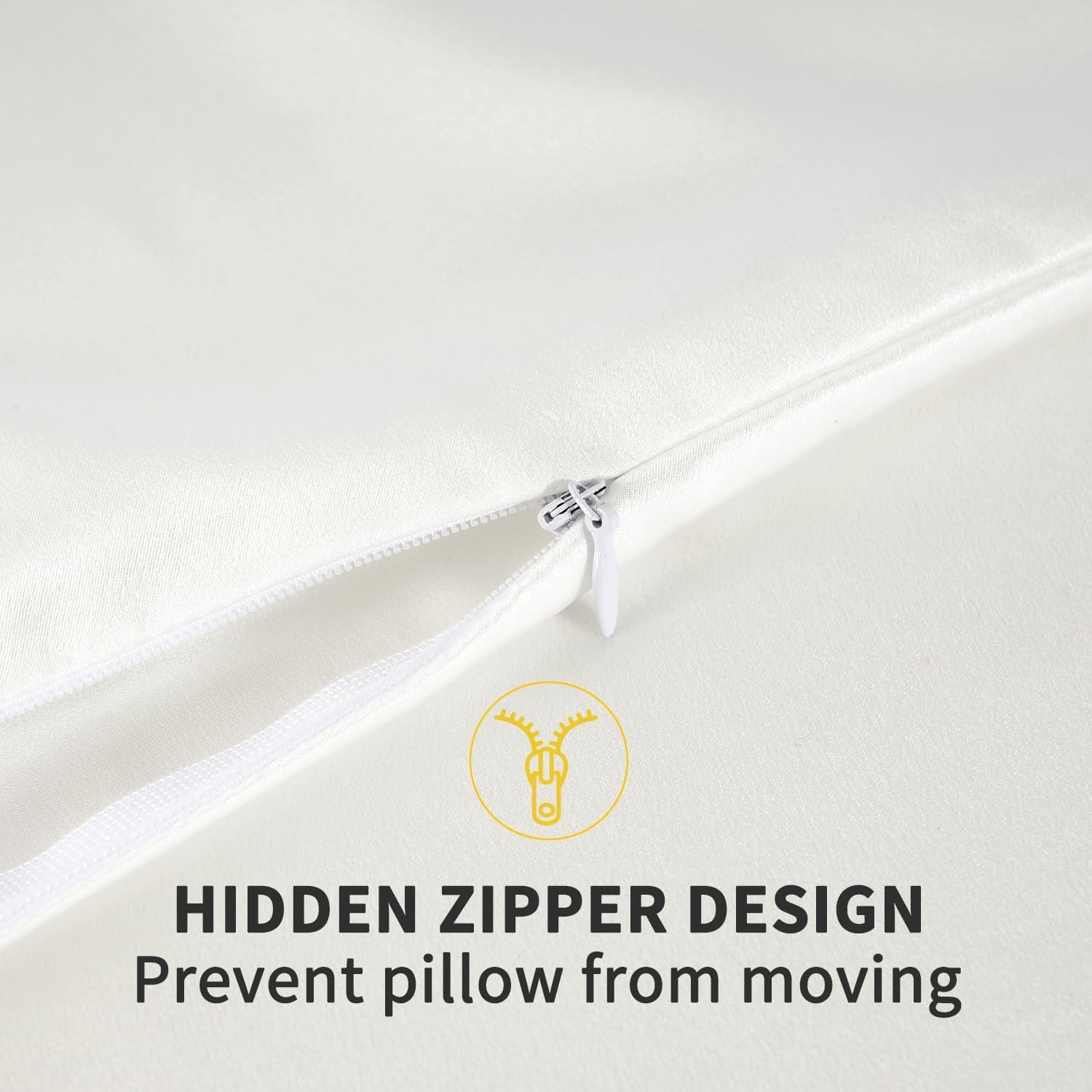
The closure is worth a look too. Envelope flaps are cheaper to make and they work, but the pillow can creep out over the night and the open end tends to look untidy. A hidden zipper keeps the pillow fully enclosed and the finished edge clean. If the pillow is visible rather than hidden under a decorative sham, that neatness matters.
Getting the size right
US pillow sizing is straightforward once you know the three standards. Standard is 20 by 26 inches. Queen is 20 by 30 inches. King is 20 by 36 inches. All three share the same 20 inch depth, so the only variable is length.
These cases are cut for queen, at 20 by 30 inches, which is around 51 by 76 cm. A standard pillow will slide in and fit, but you will have four inches of empty fabric at one end. A king pillow will not go in at all without squashing, and compressing a pillow into a case that is too short puts strain on the seams.
If you are buying in the UK or Europe, measure first. A UK standard pillow runs close to 50 by 75 cm, which is near enough to queen that it usually works. A European square at 65 by 65 cm will not fit under any circumstances.
The easiest check is to take a tape measure to the pillow you actually own, rather than trusting what the packaging said when you bought it years ago. Pillows settle and compress.
Living with silk, honestly
The washing instructions sound fussier than the reality. Zip the case shut so the zipper does not catch on anything. Put it in a mesh laundry bag. Run a cold gentle cycle with a small amount of mild, pH-neutral detergent. That is it.
The things to avoid are specific and short. No bleach, which attacks protein fibers directly. No fabric softener, which coats silk and dulls it without adding anything. No enzyme-heavy biological detergent, since those enzymes are designed to break down protein and silk is a protein. No hot water and no dryer.
Drying is where most damage happens. Hang or lay the case flat somewhere shaded with moving air. Direct sunlight fades dye and weakens fibers over time, which is true of all textiles but shows up faster on silk. If you want the case crisp again, press it with a low-heat steam iron while the fabric is still slightly damp. It comes back to shape immediately.
One more note on these particular cases. The ivory version is finished without softening agents, so the silk arrives in its natural state. If you have handled heavily treated silk before, this will feel marginally less slippery at first. It softens with the first wash and settles with use, and the upside is fabric that has not been coated with something to simulate a hand-feel it would not otherwise have.
Who this set suits
Anyone who wakes with creases pressed into one cheek, anyone with long hair that tangles overnight, and anyone who runs warm and finds cotton gets clammy by three in the morning. Silk breathes and shifts heat away rather than holding it, which is why it stays comfortable across seasons.
The two-pack matters more than it sounds. One case on the bed and one in the wash means you never have to fall back on cotton for a week while the silk dries. For a double bed, it also means both pillows match, which a single case does not give you.
And as a gift, a neutral ivory pair is low risk. You do not need to know the recipient's color scheme, and queen is the most common pillow size in US homes.
The short version
Look for 19 momme or higher for a pillowcase that will last. Check grade 6A for filament quality. Confirm that both faces are silk rather than one. Measure your pillow before you order, since queen at 20 by 30 inches is not the same as standard. Wash cold in a bag, air dry in the shade, and skip the softener.
Do those five things and a silk pillowcase stops being a delicate luxury and becomes just a better version of something you already use every single night.