

The complete guide
How to Choose a Silk Pillowcase, Momme Weight, Size and Care Explained
The small annoyance that sends people shopping for silk
Nobody buys a silk pillowcase because their bedding fell apart. They buy one because of something smaller and more persistent. Hair that looks fine at midnight and looks like a bird's nest at seven. A pillow that feels warm on one side and warmer on the other. Waking up with sleep lines pressed into one cheek because that is the side you always sleep on.
A cotton pillowcase, even a good one, has texture. Run your hand across it and you can feel the weave. That texture grips. Over seven or eight hours of turning over, it drags at hair and pulls at skin in small ways you never consciously notice. Silk does the opposite. The surface is smooth and continuous, so things slide instead of catching.
That is the whole pitch, really. It is a fabric change, not a miracle. But it is a fabric change you lie on for a third of your life, which is why so many people who try one end up buying a second for the other side of the bed.
What momme actually tells you
If you have shopped for silk at all you have seen the word momme, usually written with a number in front of it. It is the traditional Japanese weight measure for silk cloth, and it works roughly the way GSM works for cotton. Higher number, denser fabric.
For bedding, the practical range runs from about 16 momme at the light end to 25 momme at the heavy end. Below 19 the fabric starts to feel thin and sheer, and it tends to wear out faster at the seams. Above 22 you get a genuinely luxurious hand, but the price climbs steeply and the fabric can feel a little stiff until it is broken in.
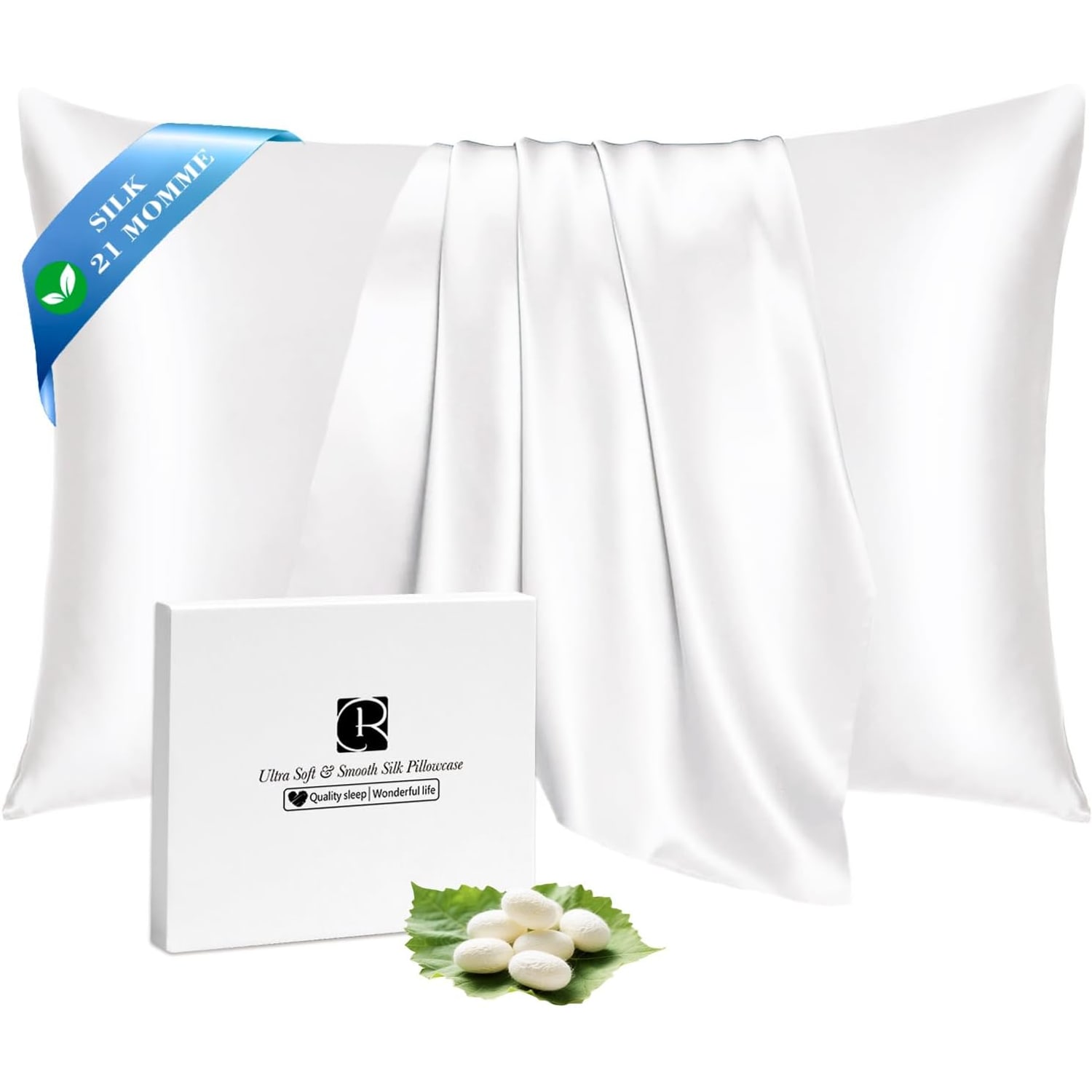
This pillowcase sits at 21 momme. That is squarely in the sweet spot most people land on. It has enough body that it drapes properly over a pillow instead of clinging to it, and enough density to survive the washing machine on a regular schedule. If someone asks what the best 21 momme silk pillowcase weight is for everyday use, the honest answer is that 21 is the weight most everyday users would pick if they tried all of them side by side.
The weave here is listed at 600 thread count. Thread count matters less in silk than it does in cotton, because momme already accounts for both the density of the weave and the weight of the yarn. Think of the thread count figure as supporting detail, not the headline.
Mulberry silk, in plain terms
Mulberry silk comes from silkworms fed exclusively on mulberry leaves in a controlled setting. The result is a long, even, uniform fiber. Other silks come from worms with mixed diets or wild habitats, and the fibers are shorter and more irregular, which makes a fabric with more texture and more variation in color.
Longer fibers mean fewer joins in the yarn, which means a smoother finished surface and a more consistent sheen. That smoothness is the entire point of a silk pillowcase, so it is worth paying attention to. This case is listed as 100% silk, described as mulberry silk at 21 momme.
Getting the size right
American pillows come in three common sizes. Standard is 20 x 26 inches. Queen is 20 x 30 inches. King is 20 x 36 inches. The width stays the same and the length changes, which is why a case that is too short bulges at the ends and a case that is too long goes baggy and slides around.
This one is cut for standard, 26 inches long by 20 inches wide, or about 66 x 51 cm if you prefer metric.
Before you order, go measure. Lay the pillow flat on the bed, do not squash it, and run a tape from one edge to the other. Older pillows can spread wider than their original size after years of use, and a very plump down pillow may read a little larger than the label claims. If your measurement comes out around 20 x 26, you want the standard. If you get something closer to 30 inches long, you need a queen case instead and this one will be too tight.
A snug fit is generally better than a loose one. A case that fits closely holds its shape through the night and does not wrinkle into ridges under your face.
Why the zipper matters more than you think
Silk pillowcases come with one of three closures. An open end, which is the simplest and the most likely to let the pillow escape. An envelope flap, which tucks the pillow in behind a fold of fabric and works reasonably well until it does not. Or a zipper.
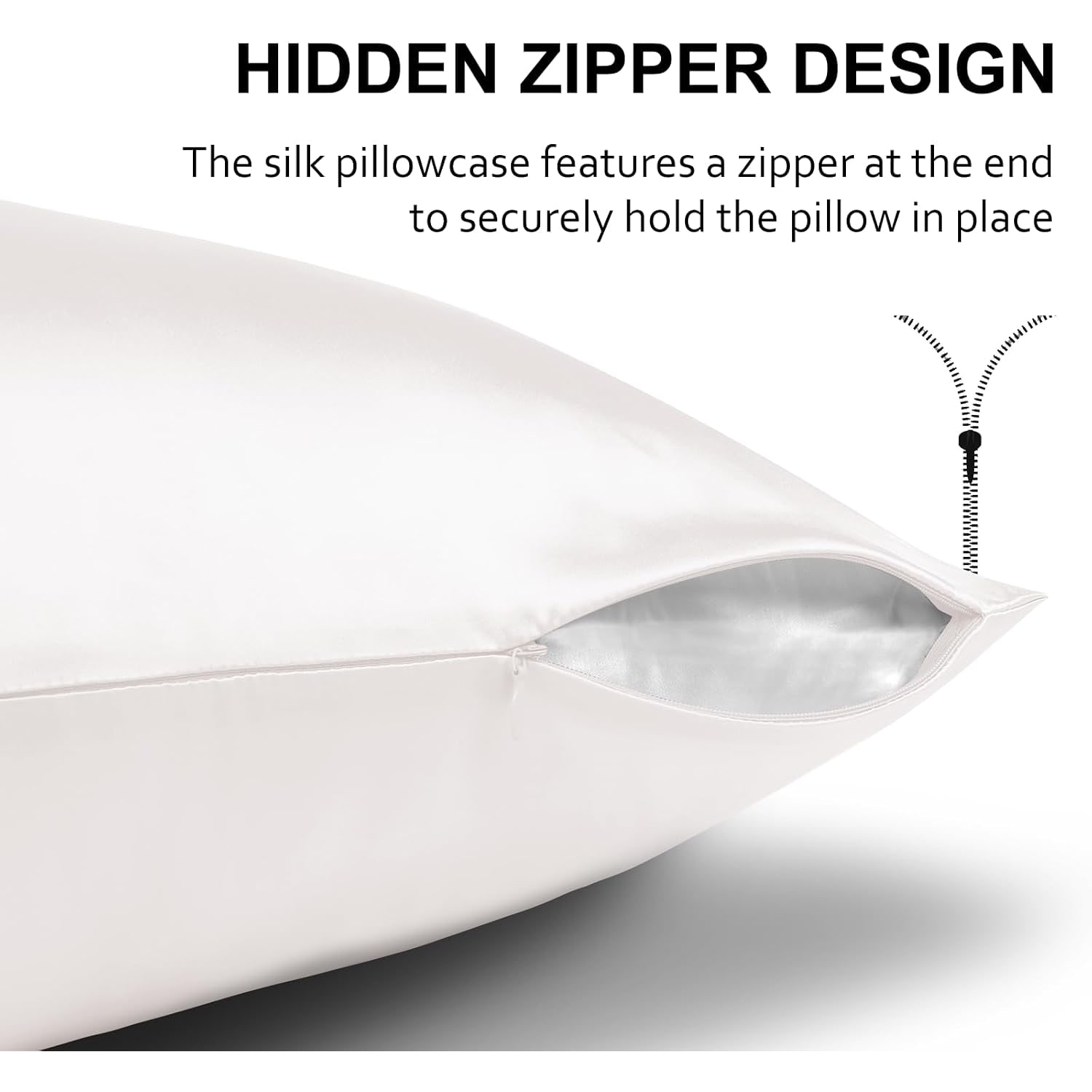
This case uses a hidden zipper along the open end. Two practical benefits follow. The pillow stays where you put it, even if you are someone who throws the pillow around at night. And the closure sits out of sight, so the edge of the case looks clean and finished when the bed is made.
There is one habit worth picking up. Run the zipper slowly and keep the silk clear of the teeth as you close it. Silk is strong along its length but it does not love being caught in metal. Thirty seconds of care here saves you from a snagged edge later.
Who tends to notice the difference
Side sleepers notice it fastest. If you spend most of the night with one side of your face pressed into the pillow, you are getting the most contact hours with the fabric, and a low-friction surface shows up in how that side of your face looks in the morning.
People with long hair are the other obvious group. Long hair spends the night trapped between a head and a pillow, dragging back and forth with every turn. Looking for the best silk pillowcase for long hair is one of the most common reasons people start shopping in this category.
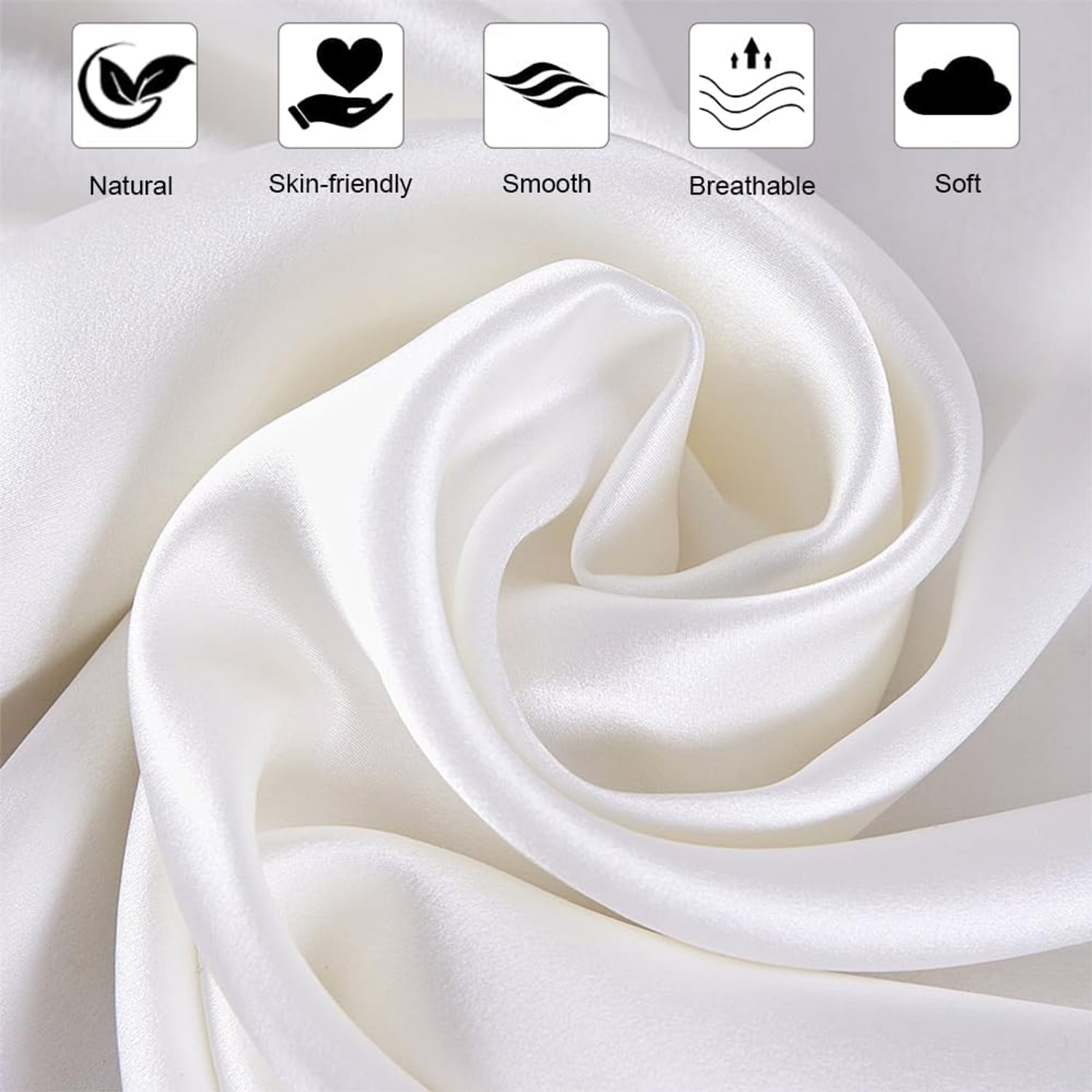
Then there are hot sleepers. Silk breathes, and it does not hold warmth against your skin the way a dense cotton case can. If you are the person forever flipping the pillow looking for the cool side, that is worth something.
And finally, people who just like nice things on their bed. There is no shame in that. A silk pillowcase is one of the cheaper ways to make a bed feel considerably more expensive than it is.
Living with it, week to week
Silk has a reputation for being difficult. It is mostly undeserved, as long as you know four rules.
Wash cool. Hot water is the fastest way to dull silk and shrink it. Cold or lukewarm on a gentle cycle is all it needs.
Use the right detergent. A mild liquid made for delicates or wool works well. Avoid anything with bleach, anything with optical brighteners, and anything advertising enzyme stain-fighting power. Those enzymes are designed to break down protein, and silk is a protein fiber.
Skip the fabric softener. Silk is already soft. Softener coats the fibers and leaves the surface feeling waxy, which defeats the purpose.
Use a mesh bag. It costs almost nothing and it stops the case tangling with zippers and buttons in the drum.
For drying, hanging it in a shaded spot indoors is the gentlest approach and it dries fast anyway. Direct sunlight will fade the ivory over time. If you prefer the dryer, use the lowest heat and pull it out slightly damp. A quick press on low heat on the reverse side will smooth out any creases.
Washing weekly or fortnightly is a reasonable rhythm. If you use rich night creams or leave-in hair products, lean toward weekly. Regular gentle washing is far kinder to silk than letting residue build and then attacking it.
On the color
Ivory white is a warm, soft white rather than a bright one. It is forgiving in a way that pure white is not, because it does not advertise every tiny shadow and it does not look clinical under a bedside lamp.
It works alongside creams, oatmeals, warm grays and most natural linen tones. It will read very slightly warmer next to a cool blue-white sheet, which almost everyone finds pleasant rather than jarring. If you are buying a neutral that will still look right when you change your bedding in two years, ivory is a sensible bet.
The short version
This is a single ivory white pillowcase in 100% silk, described as 21 momme mulberry silk with a 600 thread count weave, cut for a standard 20 x 26 inch pillow and closed with a hidden zipper. It weighs about 100 g and it is machine washable on a cool gentle cycle.
Measure your pillow first. If it comes in near 20 x 26 inches, this is your size. If you share a bed and want both sides to match, order two. And when you wash it, keep the water cool, the detergent mild and the case in a mesh bag. Do that much and it will stay smooth and good-looking for a long time.