
The complete guide
How to Choose a Queen Silk Pillowcase That Actually Fits and Lasts
The problem with the pillowcase you already have
Most people never think about their pillowcase until something goes wrong with it. Hair that was fine at bedtime looks slept on by morning. The cotton feels warm after an hour. There are creases pressed into one cheek that take half the morning to settle. None of it is dramatic. It is just a small daily annoyance that nobody connects to the fabric sitting under their head for eight hours.
Cotton is a good fabric for a lot of things, but it has a textured surface and it absorbs moisture. Those two traits are why hair catches on it and why it can feel warm and slightly damp by the early hours. Silk behaves differently. The fibers are long and smooth, which means less drag when you move, and it breathes rather than holding onto heat. That is the whole case for switching, and it is a modest, practical case rather than a miraculous one.
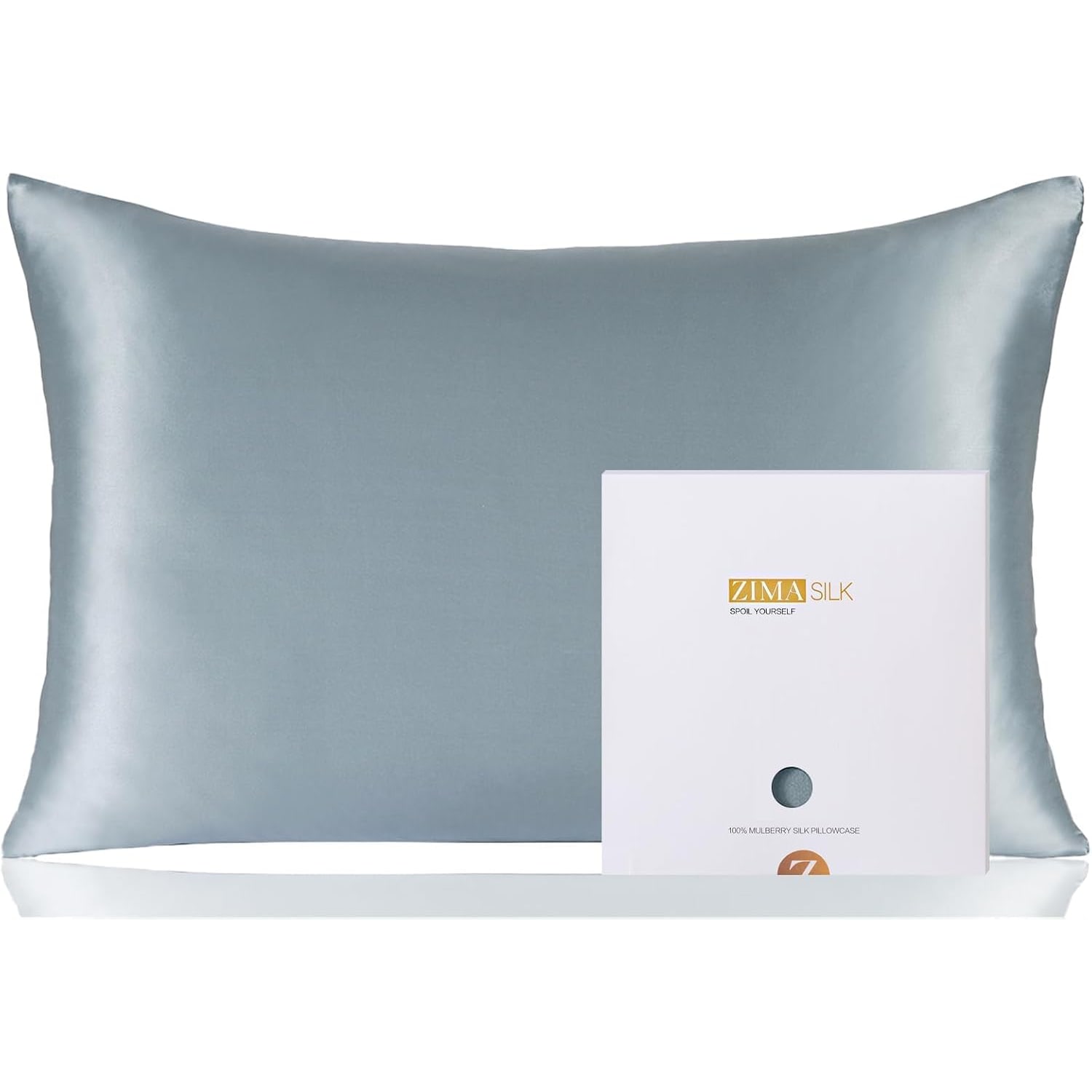
This particular case is a queen, 20 x 30 inches, in a dusty blue. Both faces are Grade 6A mulberry silk and it closes with a hidden zipper. That combination covers most of what people actually want, so let us go through what each part means.
What mulberry silk actually is
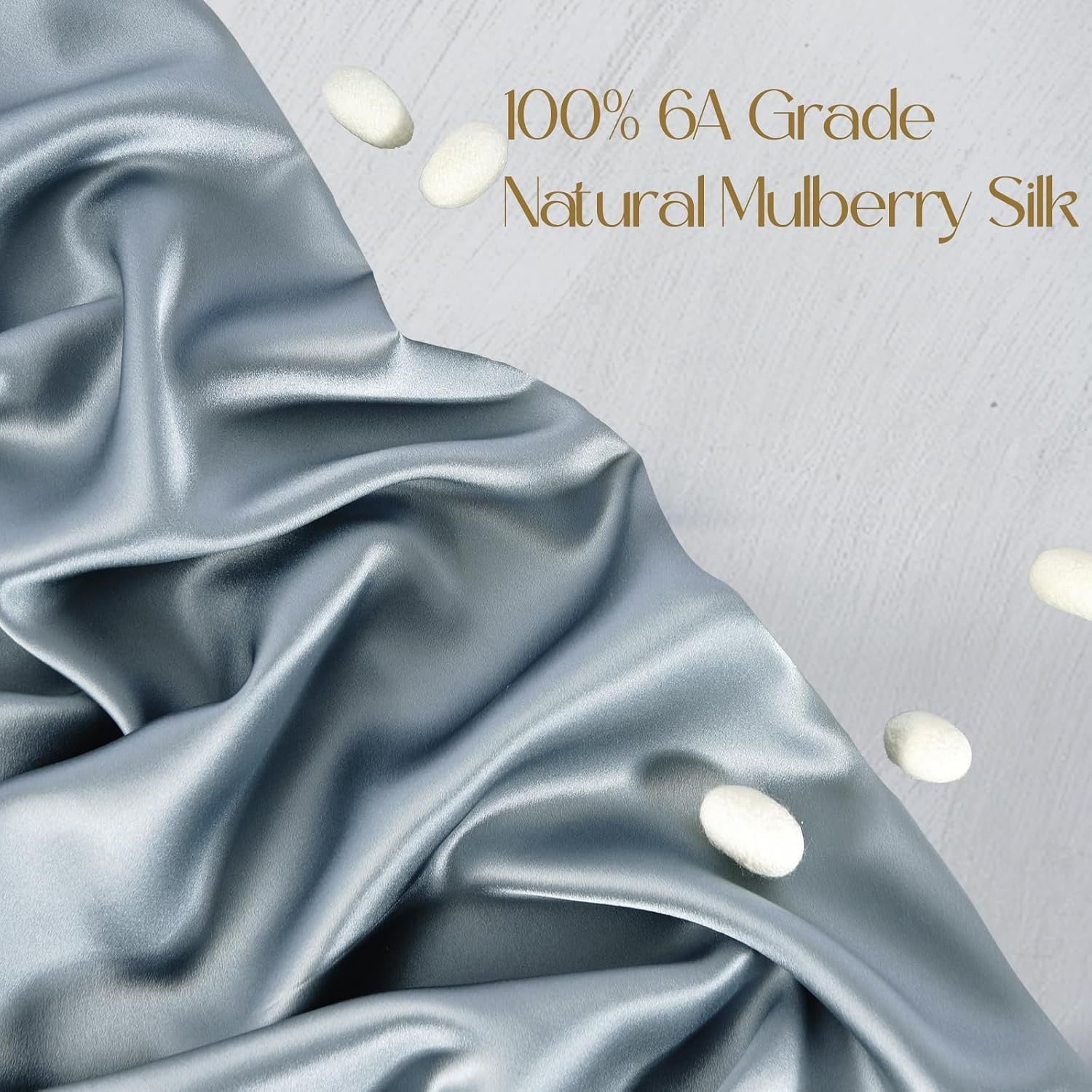
Silk comes from silkworms, and mulberry silk comes from the ones raised on a diet of mulberry leaves in controlled conditions. A controlled diet and environment produce a long, uniform fiber. Wild silks are coarser and more irregular, which is lovely in a scarf and less lovely under your face.
Within mulberry silk there is a grading system that runs from A up to 6A. The grade reflects fiber length, evenness and color consistency. Grade 6A sits at the top and gives you the smoothest surface with the fewest flaws. This case is 6A on both faces.
That phrase, both faces, matters more than shoppers expect. A great many silk pillowcases are silk on the side you see in the photograph and something cheaper on the reverse. Cotton, polyester, a blend. You feel the difference the moment you flip the pillow at night, and most of us flip the pillow at night. A best double sided silk pillowcase removes that problem completely.
Thread count, momme, and which one to care about
Silk gets measured two ways and the two get confused constantly.
Thread count is the number of threads in a square inch of the weave. This case is 600. In silk a higher count makes a denser, more even surface, so the hand feel is smoother and more consistent.
Momme is a weight measure, and it tells you how heavy and substantial the fabric is. The momme weight is not specified here. If weight is the thing you care most about, look for a case that states its momme clearly rather than guessing from thread count, because the two measure different properties.
What a best 600 thread count pillowcase gives you is an even surface with no coarse patches. That is the practical part, and it is the part you notice with your face rather than on a spec sheet.
Getting the size right
This is where most returns come from, and it is entirely avoidable. US pillow sizes run standard at 20 x 26 inches, queen at 20 x 30, and king at 20 x 36. All three are 20 inches deep, so the length is what separates them.
The trap is that bed size and pillow size are not the same thing. Plenty of queen beds are dressed with two standard pillows, and plenty of king beds carry queen pillows. If you buy a queen case because your bed is a queen, you may end up with a loose cover.
So measure the pillow. Lay it flat, run a tape along the long edge, and work from that number. If it reads close to 30 inches, this case is your size. At 26 inches you want a standard. At 36 you want a king. It takes thirty seconds and saves a return.
A note on fill. A very firm, overstuffed pillow eats some of the length, so a tight queen pillow may sit snugly in a queen case. A soft down pillow gives you more room to spare. Either is fine, it just changes how tailored the finished look is.
Why the closure matters
The zipper is the detail people skip over and then thank themselves for later.
An envelope closure works by tucking the end of the pillow under a flap. It looks tidy when you make the bed. After a few hours of movement the flap works loose and a corner of bare pillow is showing by morning. The case also drifts, so the smooth surface you paid for is not quite where your face is.
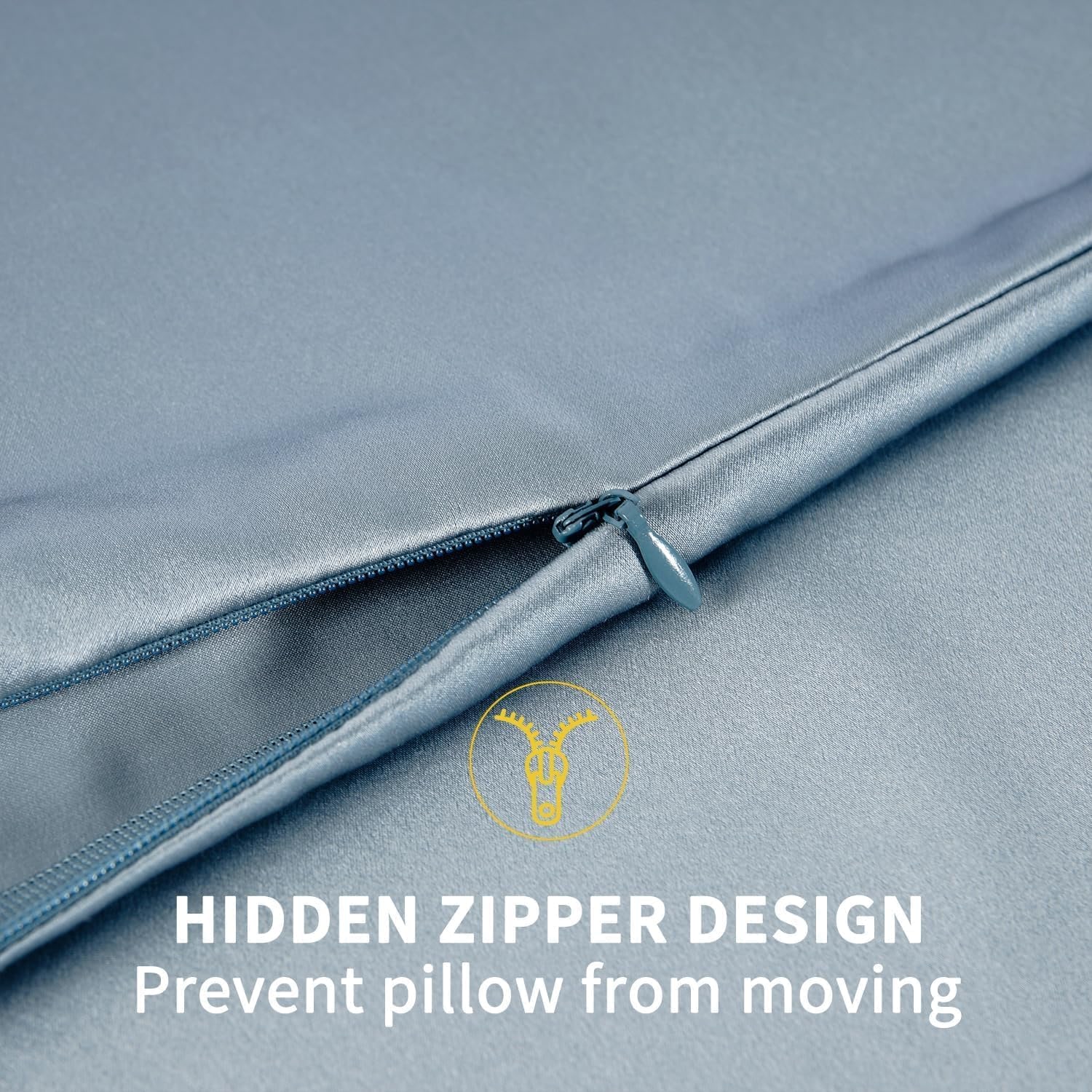
A hidden zipper holds the pillow fully inside all night. The case stays taut, the edges stay square, and nothing escapes in the washing machine either, which is a real problem with envelope styles. When looking for a best zipper closure silk pillowcase, check that the zipper is set into the side seam rather than running across the face, which is how this one is built.
Choosing the color
Dusty blue is a softened blue with gray in it. It is not a bright coastal blue and it is not navy. That makes it one of the easier accent colors to live with.
Against white sheets it reads as a quiet wash of color rather than a statement. With gray or natural linen it blends almost like a neutral. Next to navy or charcoal it lightens the whole bed. If your room has warm wood or brass in it, the gray in the blue stops it clashing.
Silk also behaves differently from cotton with color because of the way it reflects light. The shade shifts a little as the sun moves and again under lamplight at night. That slight movement is part of why a best blue silk pillowcase looks more expensive than a flat matte version of the same color.
Living with it, washing it, keeping it
Silk is less fragile than its reputation suggests, but it does ask for sense.
Wash it every week or two. More often if you use rich night creams or hair oils, since those build up on the surface and dull it. Hand washing in cool water with a mild detergent for delicates is the gentlest route. Machine washing works too on a gentle cycle, in cool water, with the case inside a mesh laundry bag so it is not rubbing against the drum or tangling with zippers from other garments.
Skip bleach, skip enzyme detergents, and skip fabric softener. Softener coats the fibers and takes away the slip, which is the exact thing you bought it for.
Do not wring it out. Press the water out between your palms or roll it in a towel. Then lay it flat or hang it somewhere out of direct sunlight. Sun is the main cause of fading, and heat is the main cause of a silk case going brittle before its time, so skip the dryer.
If creases bother you, iron on the lowest setting on the reverse side while it is still slightly damp. Honestly, most light creasing drops out on its own once the case is back on a pillow.
Owning two and rotating them halves the wear on each. That is the practical argument for a pair, more than the matching look.
Who this suits
Anyone with long or textured hair who is tired of waking up to tangles. Anyone who runs warm at night and wants something that breathes. Anyone redoing a bedroom who wants a color accent that is not a whole new set of bedding. And anyone who has tried a one-sided silk case and been irritated by the cotton reverse.
It is less useful if your pillow is a standard or a king, or if you want a patterned case, since this one is plain.
The short version
A queen silk pillowcase in dusty blue, 20 x 30 inches, with Grade 6A mulberry silk on both faces, a 600 thread count weave and a hidden zipper. Measure your pillow before ordering, wash it cool and gentle, dry it out of the sun, and it will stay smooth for a long time. Buy a second if you would rather not strip the bed on wash day.