
The complete guide
How to Choose and Wear a Square Silk Scarf
The small accessory problem
Most wardrobes have a gap that nothing quite fills. You have the shirt, the jacket, the shoes, and the whole thing still looks unfinished at the neckline. Buying another jacket does not fix it. Buying more jewelry does not always fix it either, especially if you work somewhere that frowns on anything loud.
A square silk scarf fixes it, and it does so for very little money and almost no space in a drawer. Tie one at the throat and a plain white shirt suddenly looks deliberate. Wrap it over your hair on a windy day and a messy morning stops showing. Loop it through a handbag handle and a bag you have carried for four years looks like a different bag.
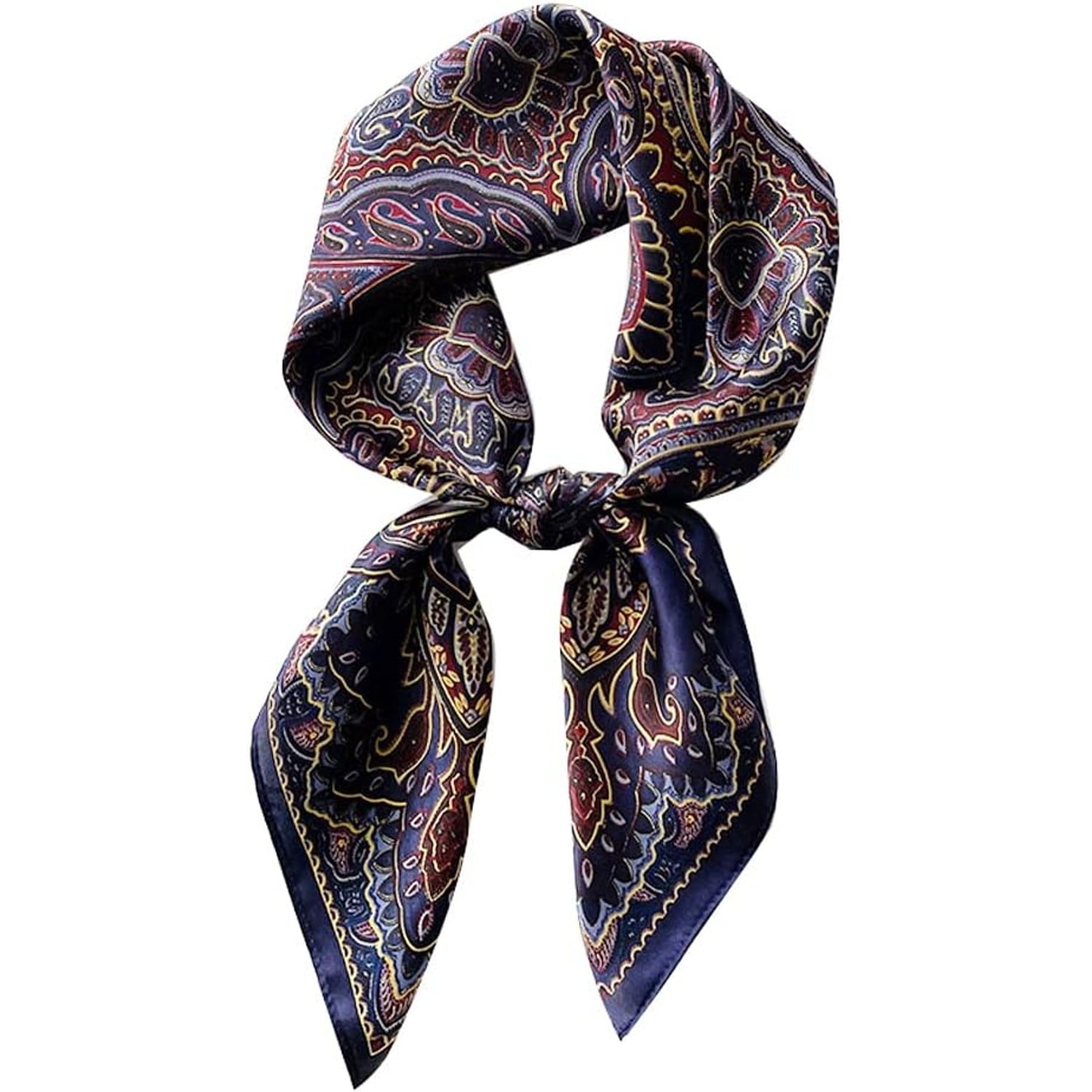
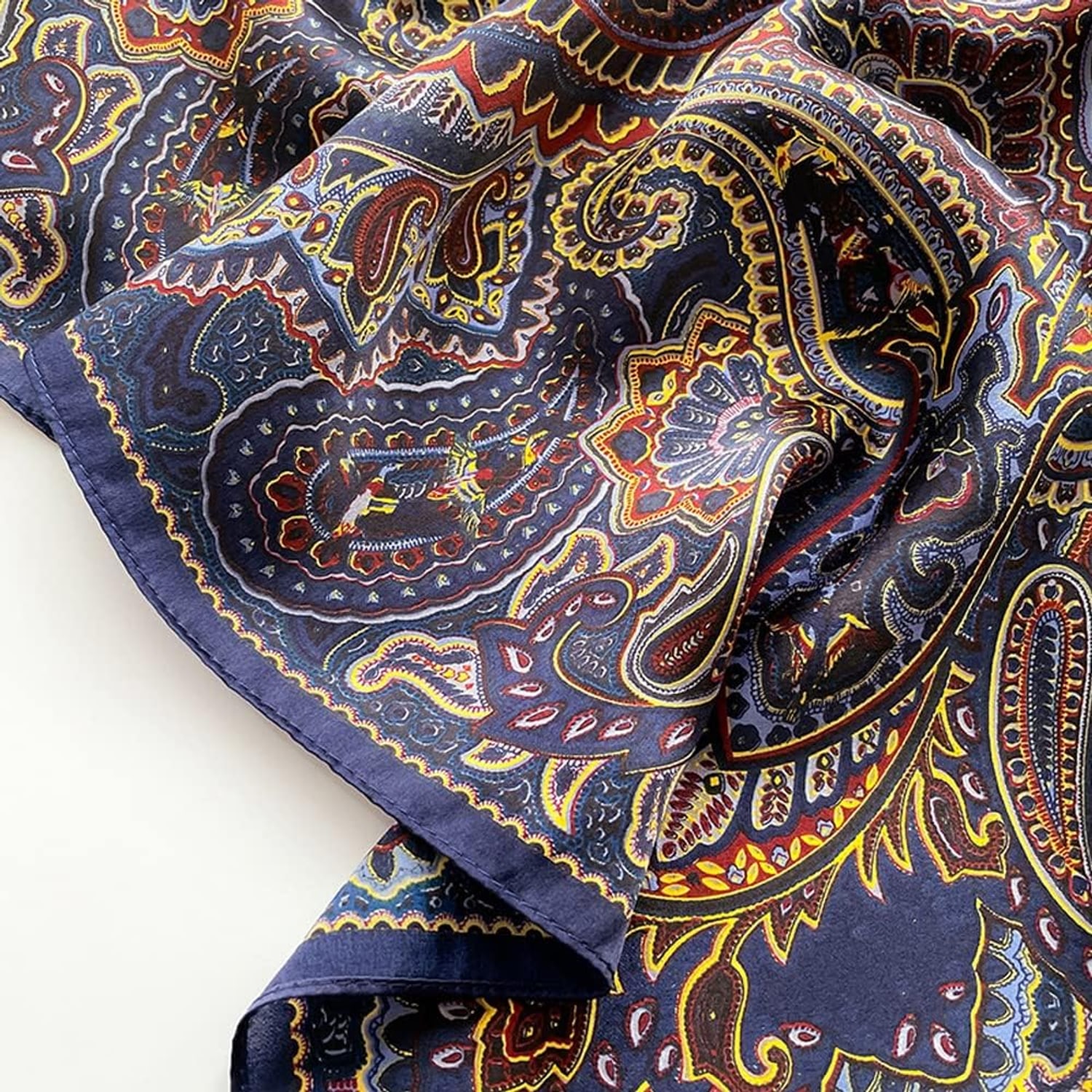
This one is 26 inches square, blue paisley, and cut from 100% mulberry silk. Below is what those details actually mean when you are wearing it.
Why mulberry silk behaves differently
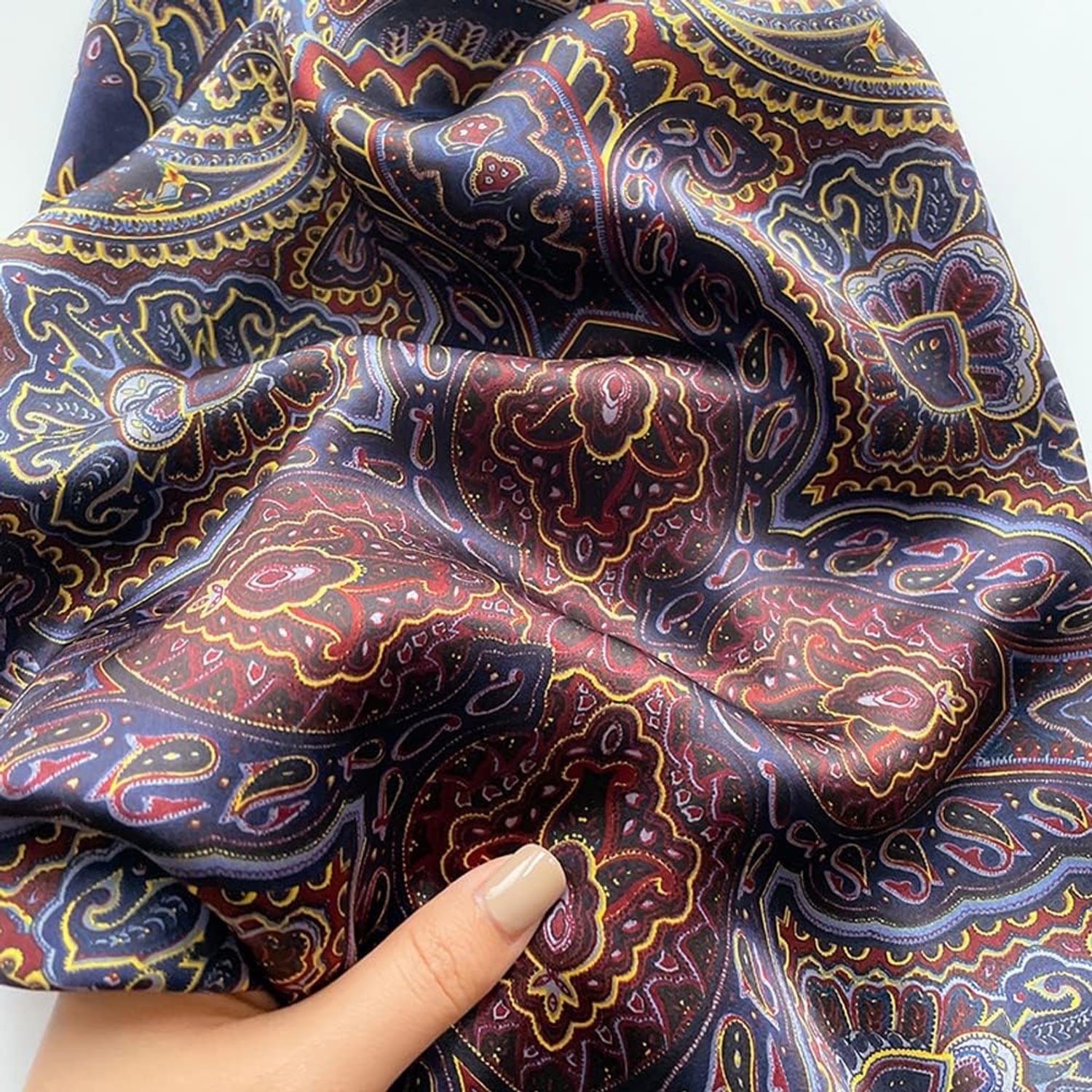
Silk is not a single material. The term covers everything from rough, slubby wild silk to the fine, even fabric most people picture. Mulberry silk sits at the smooth end. The silkworms are raised on mulberry leaves only, which produces unusually long and uniform filaments, and those filaments weave into a surface with very few bumps or breaks in it.
You can feel the difference straight away. The fabric glides across itself rather than catching. Light hits the surface and spreads softly instead of flaring into a hard shine. And when you tie a knot, the scarf settles. Cheaper polyester "silk-look" squares tend to spring back out of a knot and hold a stiff, crumpled shape all day. Silk falls.
That drape is the whole point. It is also the reason silk feels cool in summer. The fabric is thin, it breathes, and it does not trap heat against the skin the way a dense synthetic weave does. In cooler weather it works the other way, trapping a thin layer of warm air at the neck, which is exactly where a lot of us lose heat.
Why 26 inches is the useful size
Square silk scarves come in roughly three sizes. Small squares around 20 inches are really only neck ties. Large squares at 35 inches and up are wraps, beautiful but bulky, and they can overwhelm a smaller frame. The 26 inch square sits in between, and that is why it is the one most people reach for.
At this size you can:
Fold it on the bias into a long narrow band and knot it close at the throat for a neat, tailored look under a collar.
Fold it into a triangle, place the long edge at your forehead and tie the ends behind, for a proper headscarf that actually covers hair.
Twist it into a rope and wrap it twice around a wrist or a ponytail.
Thread it through belt loops as a soft, flat belt that ties at the hip.
Loop it around a bag handle, around a hat band, or around a luggage grip so you can spot your suitcase on the carousel.
None of that needs a pin, a ring or any special technique. If you are after the best silk neck scarf to learn knots on, mid-size squares are where every tutorial starts.
Who this suits
Anyone who wants one accessory that works with a lot of outfits. Blue paisley is a forgiving print. It sits naturally with denim, navy, white, cream, camel and gray, which covers most working wardrobes. It is quiet enough for an office and interesting enough that people notice it.
It suits travelers. The scarf weighs about 0.88 oz. That is less than a pair of sunglasses, and it compresses into any corner of a bag. On a plane it covers your shoulders when the cabin runs cold, it folds into an eye cover, and it saves your hair from the headrest.
It suits people who find jewelry fussy. A knotted scarf gives you color and shape at the neckline without anything hard against the skin, without clasps, and without the worry of losing a stone.
And it suits people who sleep with their hair wrapped. Silk is smooth, so hair slides across it with less friction than it does over cotton. That is a property of the fabric, not a promise about your hair, but it is why silk sleep wraps are popular.
How to choose between square and oblong
If you are deciding between shapes, think about the knot you picture.
Squares fold into triangles, which means they sit flat and wide across the chest or over the hair. They are the shape for headscarves, bandana ties, neckerchief knots and anything you want to look structured.
Oblongs are long and narrow. They loop and hang, they work as a skinny tie or a long drape down a coat, and they are easier if you want length rather than coverage.
Most people end up with both eventually. If you are only buying one, a 26 inch square does more jobs.
Color is the other decision. A patterned square like this blue paisley brings the interest, so it works best over plain clothes. If your wardrobe is already busy, a solid scarf is the safer pick. If your wardrobe is mostly plain, a print earns its keep every time you wear it.
Looking after it
Silk is tougher than its reputation suggests, but it does not like three things: heat, hard mechanical action, and alcohol.
Wash it by hand, on its own, in cool water below 86F (30C). Use a small amount of neutral detergent or a dedicated silk wash. Swish it through the water for a minute or two. Do not rub the fabric against itself and do not scrub a stain. Rinse in cool water until it runs clear.
Never wring it out. Lay the scarf flat on a dry towel, roll the towel up, and press. Then unroll it and dry it flat or over a rail, in the shade. Direct sun is the fastest way to dull a printed color, and a hot dryer will damage the fibers.
If it needs pressing, use the lowest silk setting on your iron, work on the reverse side, and put a thin cotton cloth between the iron and the scarf. Keep the iron moving.
Spray perfume and hairspray first, let them dry, and then put the scarf on. Alcohol can leave a mark on silk that does not wash out. For makeup transfer or anything oily, dry cleaning is the better call than attacking it at home.
Store it loosely rolled or folded rather than crammed into a tight drawer corner. Silk creases, and deep creases set over time.
A few knots worth knowing
The slip knot is the easiest. Fold the square on the bias into a band, drape it around your neck with uneven ends, tie a loose single knot in the longer end about a third of the way down, thread the shorter end through, and slide the knot where you want it.
The neckerchief is the classic. Fold into a triangle, point down at the front, ends crossed behind the neck and brought forward, then tied in a small knot under the point.
The bag wrap takes five seconds. Narrow band, one loop around the handle, small knot, trailing ends.
The head wrap gives the most coverage. Triangle fold, long edge at the hairline, ends tied at the nape, with the point tucked up underneath.
The short version
This is a 26 x 26 inch square of 100% mulberry silk, printed in blue paisley, weighing about 0.88 oz. The size is the useful one, big enough for a headscarf fold and tidy enough for a neck knot. The silk gives it the drape and the soft shine that synthetic squares never quite manage.
Hand wash cool, dry flat in the shade, keep it out of the sun and away from hairspray, and it will look the same in five years as it does on day one. If it turns out not to be the right color for you, it comes back within 14 days as long as it is unworn and unwashed.