
The complete guide
How to Choose and Wear a Square Silk Scarf
The problem with most accessories
Most accessories ask something of you. Jewelry needs a matching metal. A hat needs a head shape that agrees with it. A statement bag needs the rest of the outfit to quiet down. A square silk scarf asks for almost nothing. You fold it, you tie it, and the outfit you were already wearing looks like it had a plan.
That is the real argument for keeping one in a drawer. Three plain shirts and one good scarf cover more ground than six shirts. It is also why a scarf travels so well. It weighs nothing, it folds flat, and it changes what the camera sees without changing what you packed.
This guide covers what a 26 inch square actually does, how mulberry silk behaves, how to fold it without a tutorial open on your phone, and how to keep it looking like it did on the first day.
Why 26 inches is the useful size
Square scarves come in a range of sizes, and the number matters more than people expect.
Below about 20 inches you have a pocket square or a tiny bag charm. Pretty, limited. Above about 35 inches you are into shawl territory, which is a different garment with a different drape. The 26 inch square (65 x 65 cm) sits in the middle, and that middle is where the versatility lives.
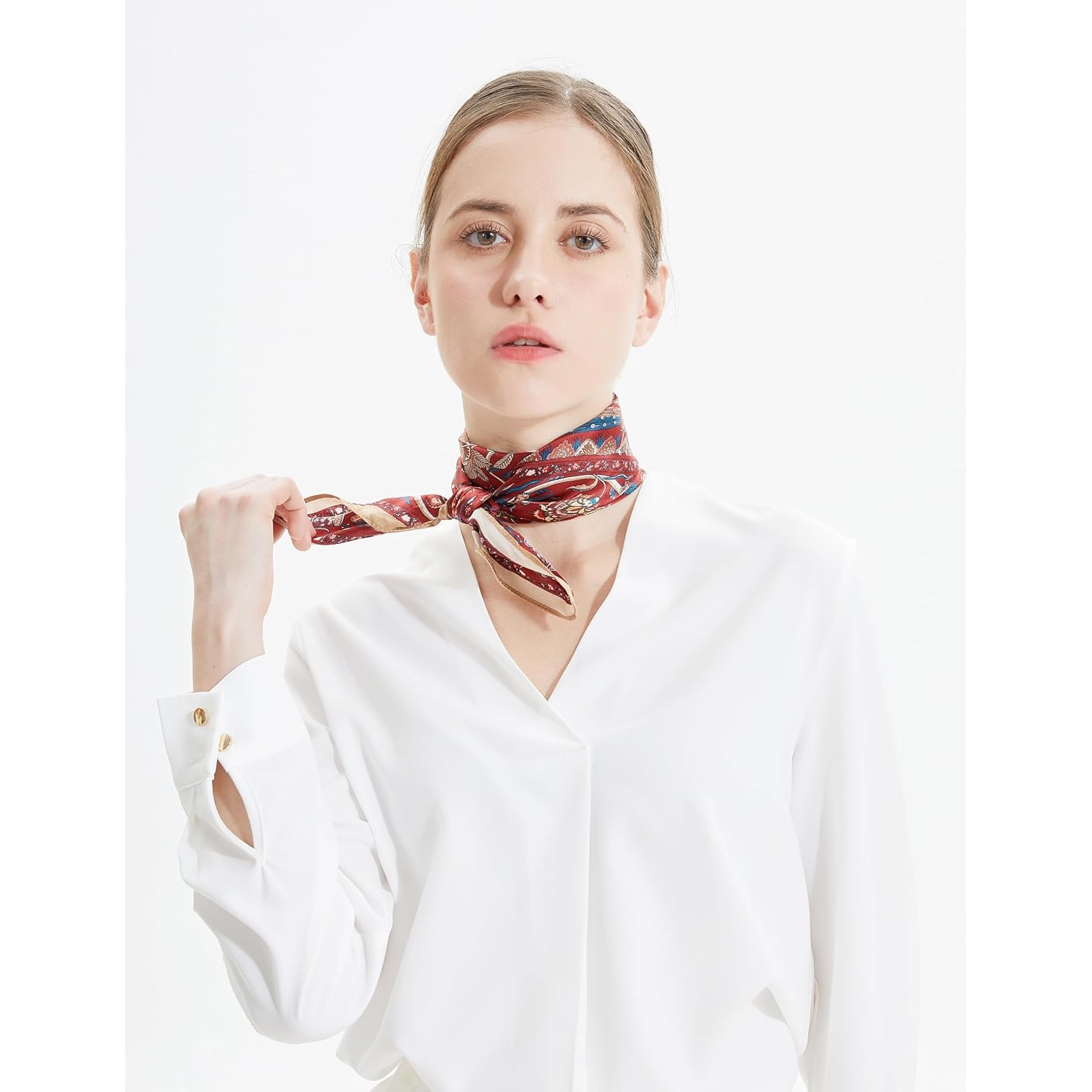
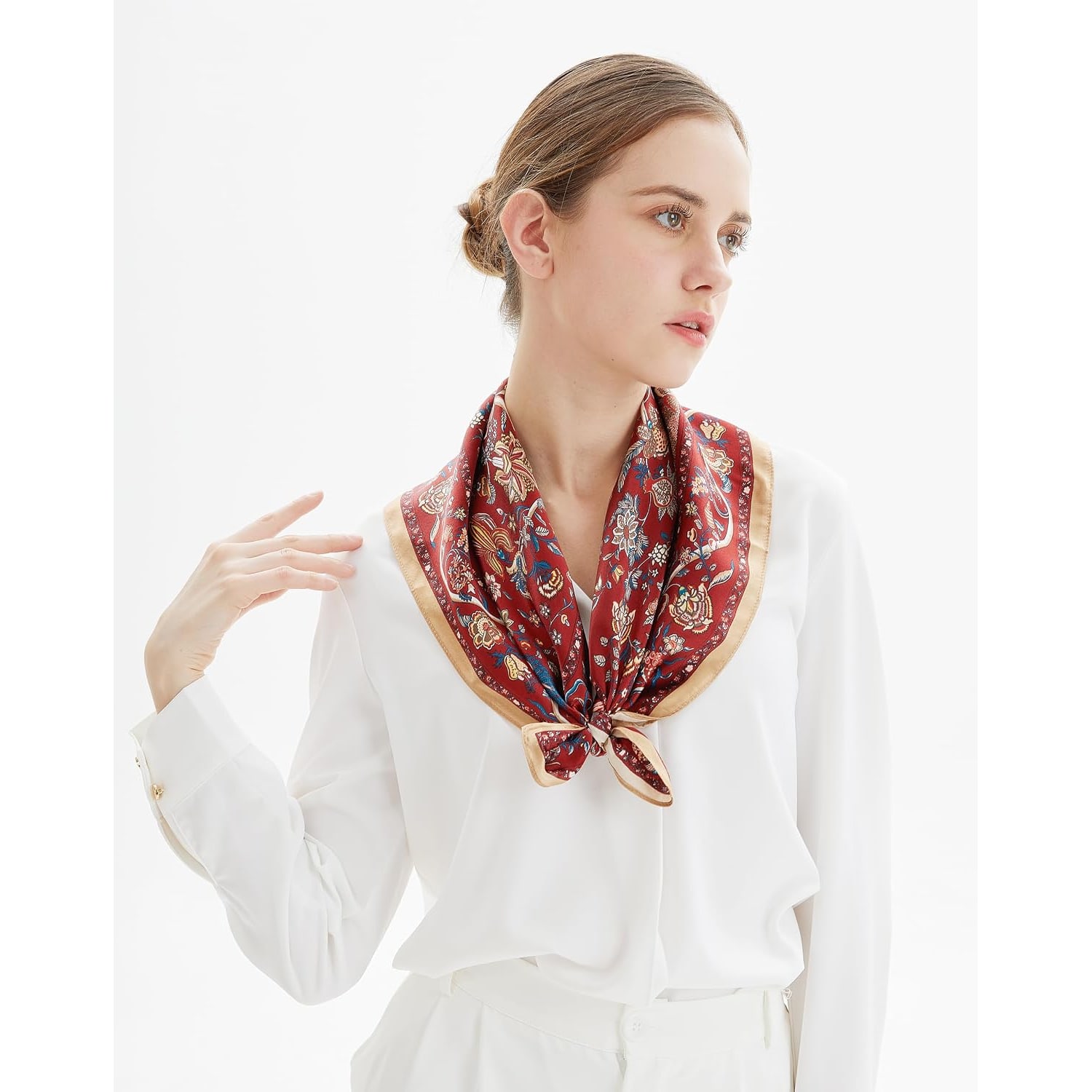
At this size the scarf folds into a triangle wide enough to cover the hair and tie at the nape. Rolled down, it makes a neckerchief that sits flat under a collar instead of bulking up. Rolled tighter still, it becomes a band for a wrist, a ponytail, a hat or a handbag handle. One square, five or six jobs. If you are shopping for the best 26 inch silk scarf, you are really shopping for the one that handles all of those without feeling like a compromise in any of them.
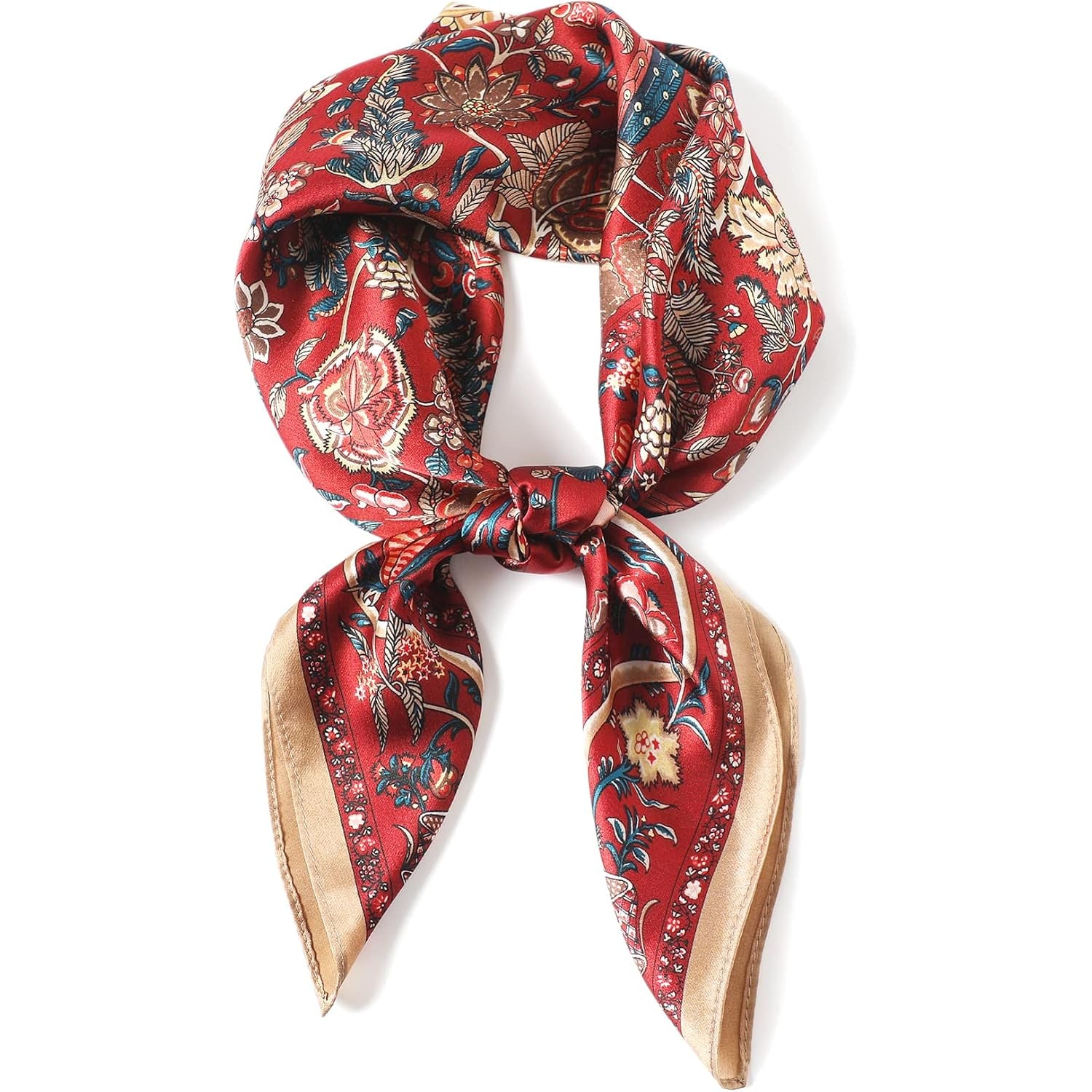
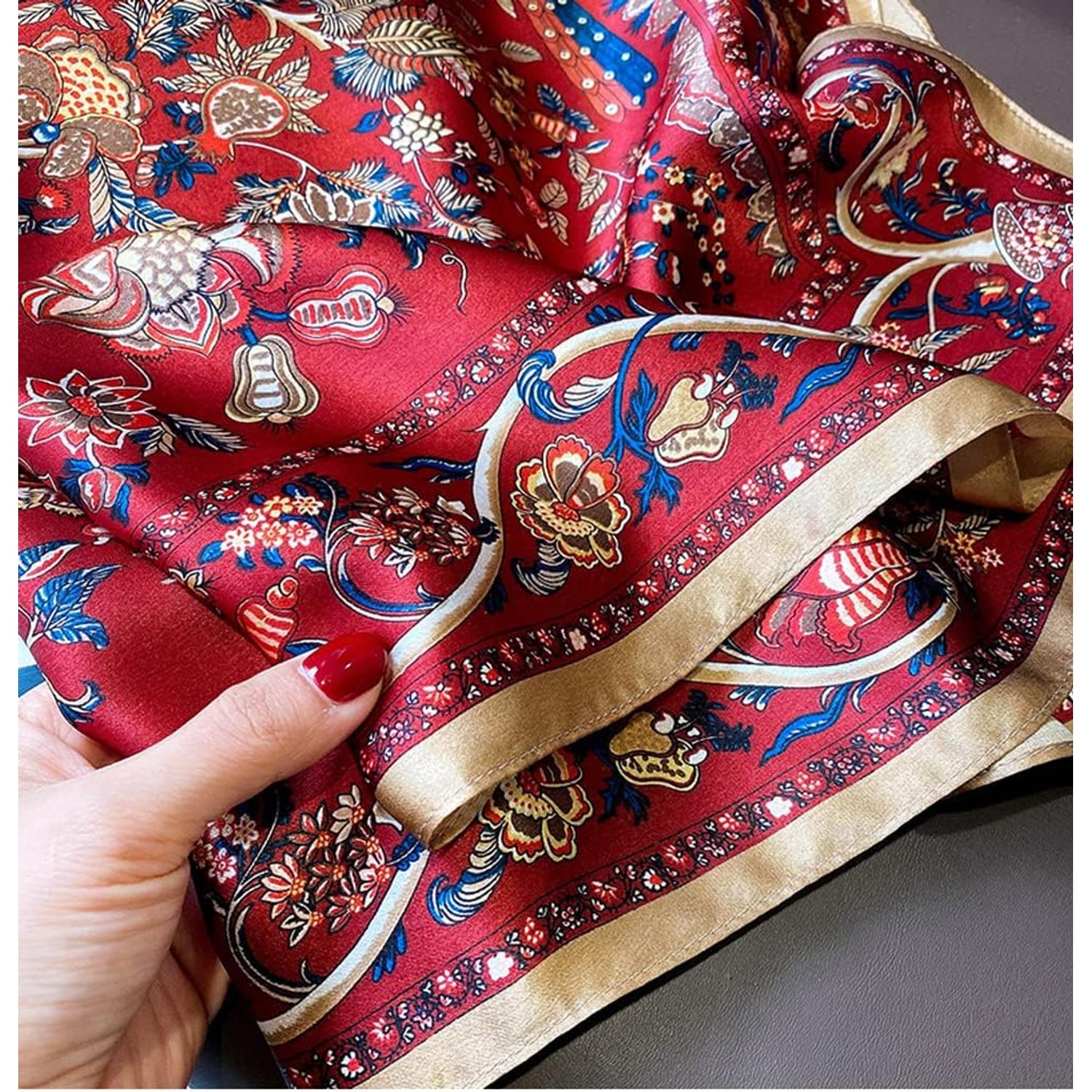
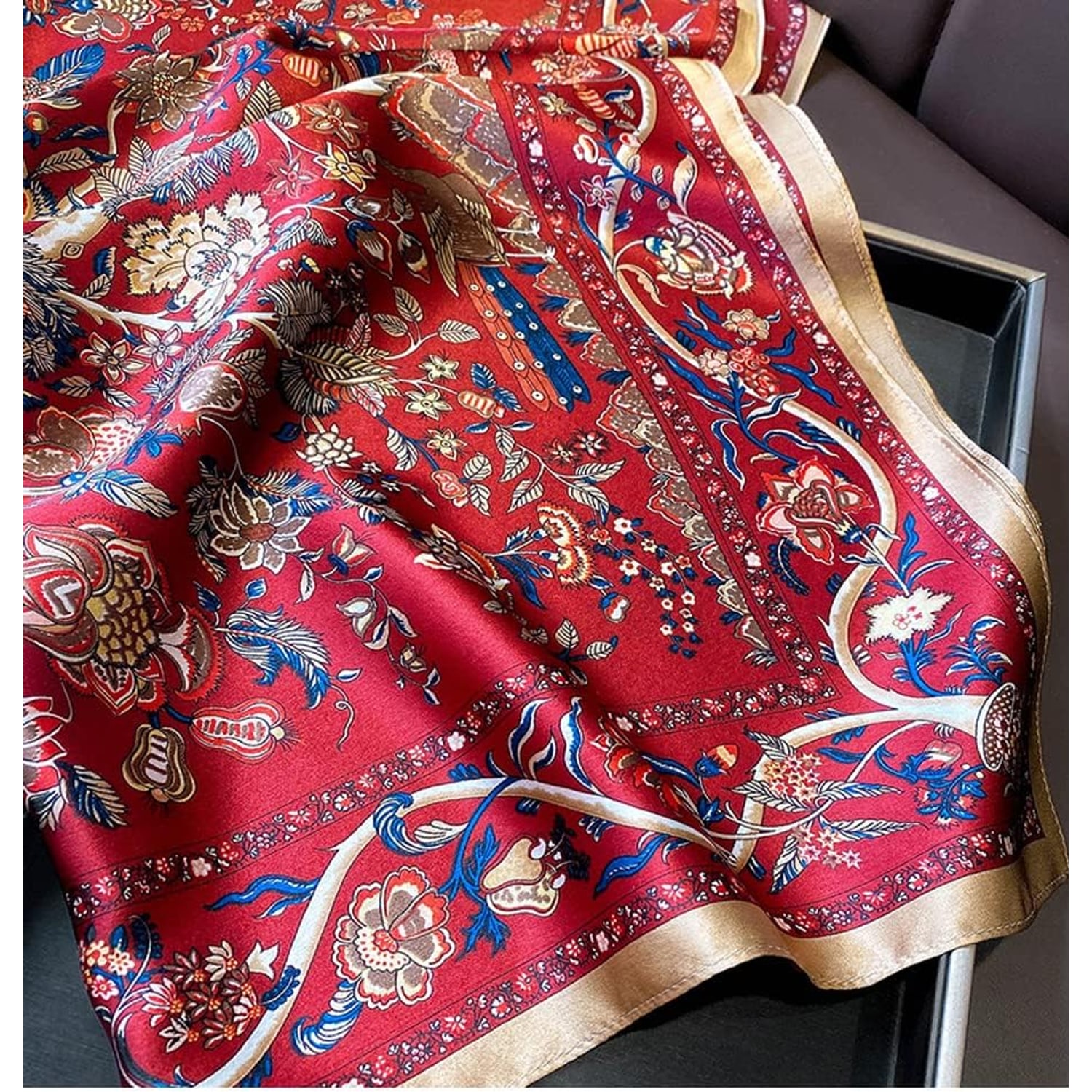
The red floral print pushes it further toward statement piece than background piece. That is a deliberate choice. A neutral scarf disappears into an outfit. A red one gives a plain coat somewhere to look.
What mulberry silk actually is
Silk gets used loosely as a word. Mulberry silk is more specific.
It comes from Bombyx mori silkworms raised on a controlled diet of mulberry leaves. That diet and that controlled environment produce unusually long, even filaments. Long filaments mean fewer joins in the yarn, which means a smoother surface on the finished cloth and a more consistent sheen. Wild silks, by comparison, have shorter and more irregular fibers, which gives a more textured, slubby fabric. Neither is wrong, they just do different things.
For a scarf, the smooth version is what you want. Smoothness is why a silk square slides over hair and skin with much less friction than cotton or wool. It is why a silk knot settles into place rather than catching on itself and bunching. It is also why the color on a printed silk looks deeper than the same print on a matte fabric, because the surface is returning light rather than scattering it.
This scarf is listed as 100% mulberry silk. The momme weight, which is the traditional measure of silk density, is not given, so treat it as a lightweight fluid square rather than a substantial heavy one. For neck and hair use that is exactly the right end of the scale.
Who it suits
Someone who wants an easy way to add color. If most of your wardrobe is black, navy, gray or denim, a single red floral square does more than another plain top would.
Someone who travels. It takes up no space, it recovers from being crushed in a bag, and it works in hot climates where a wool scarf is unthinkable.
Someone looking for a gift without a size problem. A scarf fits everybody. That alone solves most of the awkwardness around buying clothing for other people.
Someone who ties their hair back a lot. Rolled into a band, a silk square works as a hair tie, a headband or a wrap, and the smooth surface is gentler on hair than a hard elastic.
It is less suited to anyone who needs genuine warmth. This is a thin layer, not a winter scarf. It is also not a shoulder wrap. If coverage is the point, go up to a 35 inch square or a long rectangle.
Learning three folds and stopping there
You do not need a styling course. Three folds cover almost everything.
The diagonal fold is the foundation. Take the square, fold it corner to corner, and you have a triangle. That triangle, placed point down at your chest with the ends tied behind your neck, is a bandana. The same triangle, placed over the hair with the long edge at your forehead and tied at the nape, is a head scarf. People searching for the best silk head scarf approach are usually describing this exact fold.
The band fold is the second one. Start from the triangle and keep folding the long edge up toward the point, two or three times, until you have a strip a few inches wide. Tie that at the throat for a neckerchief, around the head as a headband, or at the base of a ponytail.
The roll is the third. Keep folding the band until it is a narrow rope. That is your wrist tie, your bag handle wrap, your hat band. It is also the neatest version of the neck knot if you want something small and tidy against the skin.
Everything else is a variation on those three. The only real technique is to keep the folds even as you go, because an uneven fold shows at the knot.
Pairing the print
Red floral is a loud enough print that it prefers quiet company. Against navy it reads as classic. Against black it is sharp. Against cream or white it feels lighter and more summery. Against denim it is relaxed, which is probably the easiest look to pull off and the one most people default to.
Where it gets tricky is pattern on pattern. A floral scarf over a striped shirt can work if the scale is different enough, but it needs a careful eye. Over another floral, it rarely works.
One useful rule: if the scarf is the brightest thing you are wearing, you are probably fine. If something else is competing, pick one and lose the other.
Looking after it
Silk is not fragile, but it is particular. The care instruction here is hand wash only.
Use cool water, below 86F (30C), and a neutral detergent or something sold specifically for silk. Swirl the scarf through the water rather than rubbing or scrubbing it. Rinse in clean cool water until there is no soap left. Then lay it on a towel, roll the towel up and press the water out. Do not wring it, because twisting wet silk stretches the fibers unevenly.
Dry it flat or hang it in the shade. Direct sun fades dye, and a radiator or dryer will make the fabric brittle over time.
If you want to iron it, use the lowest silk setting and put a thin cotton cloth between the iron and the scarf. Slightly damp silk presses better than bone dry silk.
Reds can release a little dye on the first wash. Wash it alone the first time and do not let it soak.
Dry cleaning is a valid alternative if hand washing is not your thing. Just tell the cleaner it is 100% silk.
For storage, fold or roll it loosely into a drawer. Hanging it on a hook for months pulls the fabric out of shape, and a sealed plastic bag traps moisture.
The short version
A 26 x 26 inch (65 x 65 cm) square of 100% mulberry silk with a red floral print. Smooth, light, and sized for the jobs people actually ask a square scarf to do: a neck knot, a head wrap, a hair band, a wrist tie or a bag accent.
It will not keep you warm in January and it is too small to use as a shawl. Within those limits it is one of the most useful things you can keep in a drawer, and one of the easiest gifts to buy for someone whose size you do not know.
Hand wash in cool water, dry flat, store it loosely folded, and it should look the same in five years as it does in the first week.