
The complete guide
The Honest Buyer's Guide to Silk Sleep Bonnets
The problem nobody mentions until it has already happened
You go to bed with hair that looks good. You wake up with frizz at the crown, a flattened side, and curls that have lost their shape. Nothing dramatic happened. You just moved your head maybe thirty times against a cotton pillowcase, and cotton grips.
That grip is the whole issue. Cotton is spun from short fibers, which means the surface of the fabric is covered in tiny loose ends. Hair catches on them. Over a night that is barely noticeable, but over a year it shows up as roughed-up cuticles, broken ends and sets that never last as long as they should.
A silk bonnet solves it by changing the surface your hair touches. Instead of sleeping against a textured weave, your hair sits inside a smooth one. It is a small intervention with a cumulative payoff, and it costs you nothing in time once it becomes a habit.
What 19 momme actually buys you
Momme is the unit used to measure silk weight. One momme is roughly the weight of a set area of fabric, so a higher number means a denser weave with more silk in it.
Cheap silk accessories often sit in the 12 to 16 momme range. They feel light, sometimes a bit flimsy, and they wear thin fast. At the other end, 25 momme silk is heavy and more expensive than most people want for a cap. Nineteen momme sits in the middle, and it is the same weight that quality silk pillowcases usually use. It feels substantial between your fingers, drapes properly, and holds up to being washed every week or two.
This bonnet is 19 momme mulberry silk, described by the maker as 6A grade. Mulberry silk simply means the silkworms were fed on mulberry leaves, which produces long, uniform filaments. Those long filaments are what make the finished fabric smooth rather than fuzzy.
The band is the part most people get wrong
Ask anyone who has given up on bonnets why they stopped, and the answer is usually the band. Wide elastic feels secure for the first hour and then starts pressing. You wake with a line across your forehead or a dull ache behind one ear. Side sleepers get the worst of it, because body weight pushes the band into the ear through the pillow.
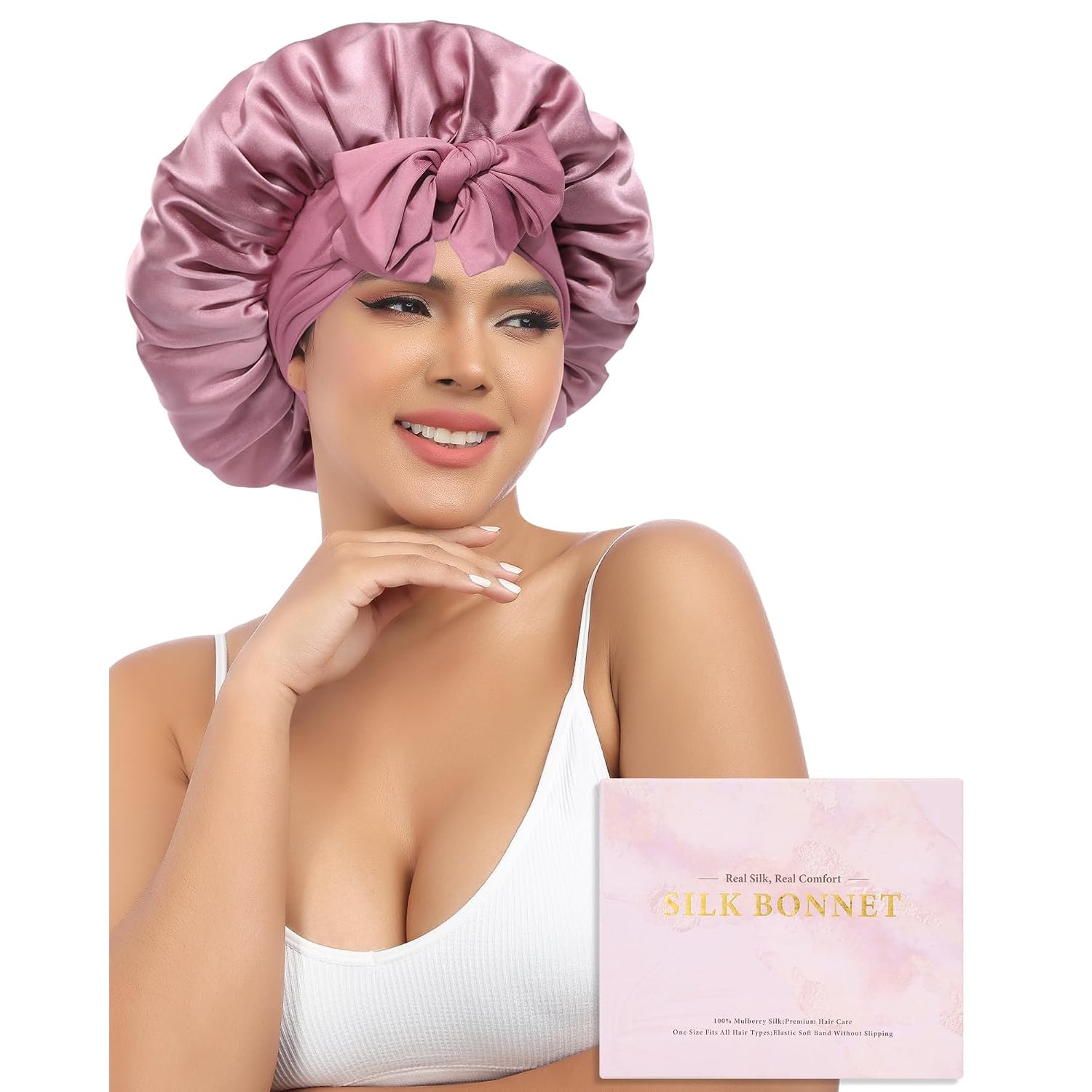
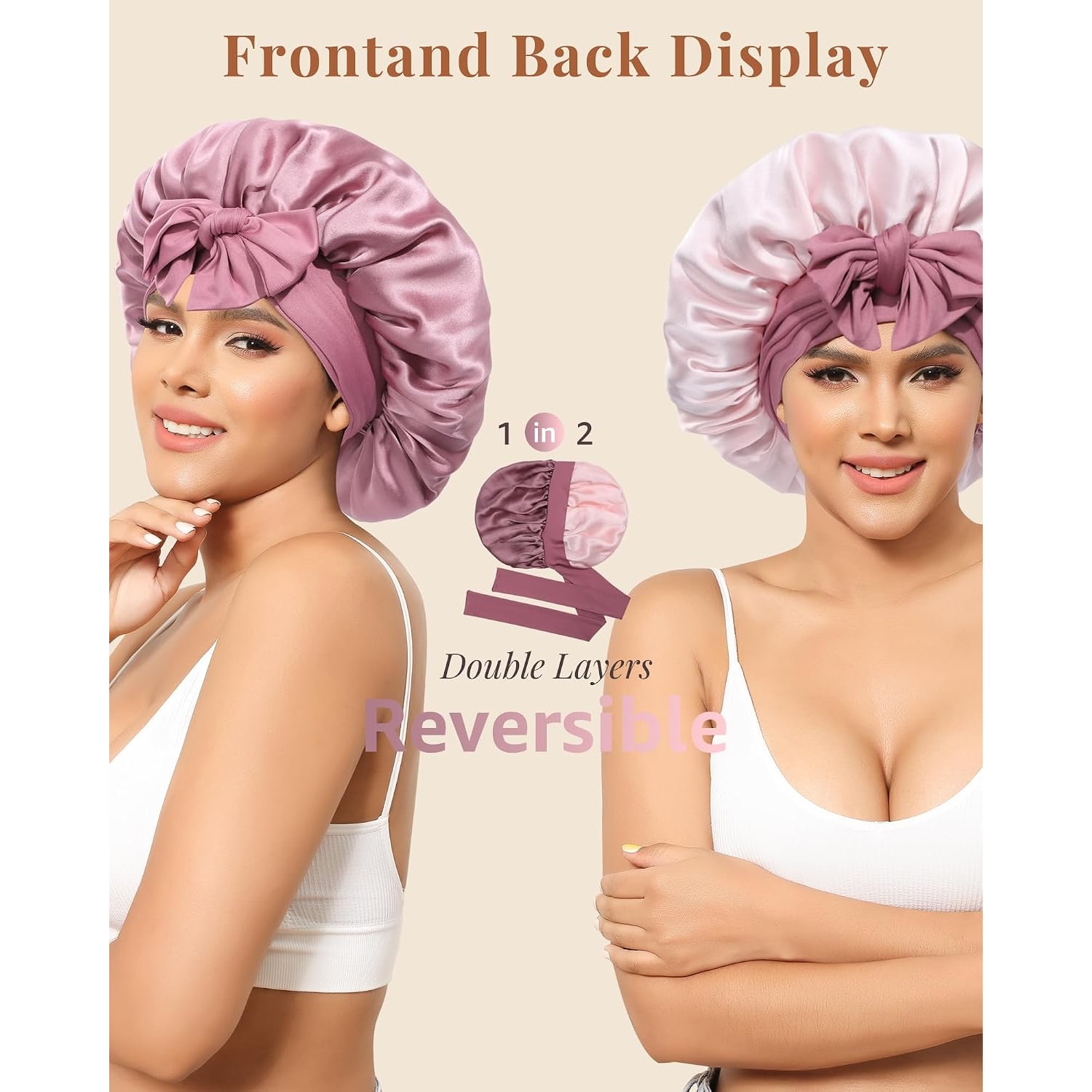
This cap uses a long silk tie instead. You set the tension yourself, knot or bow it at the front, and that is it. Want it barely there? Tie it loose. Toss and turn? Pull it firm. The key difference is that a soft tie distributes pressure differently from a thick elastic ridge, so there is nothing hard sitting in one spot for eight hours.
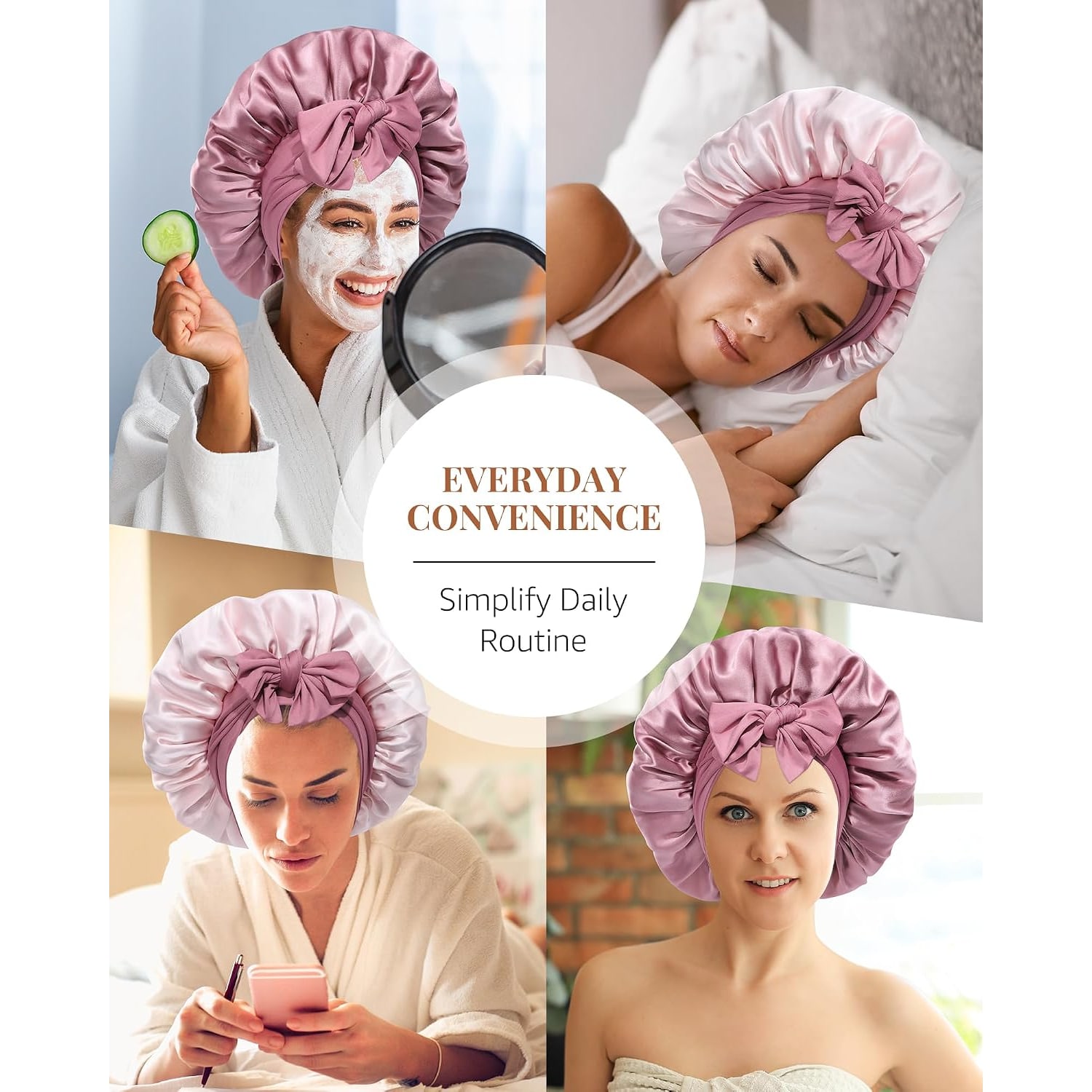
The tie also gives the cap a second life. Bowed at the front, it reads as a turban rather than sleepwear, which is why people keep it on through a skincare routine or a slow Sunday morning. If you have been looking for the best silk hair wrap for side sleepers, the closure matters more than almost any other feature.
Does the size suit your hair?
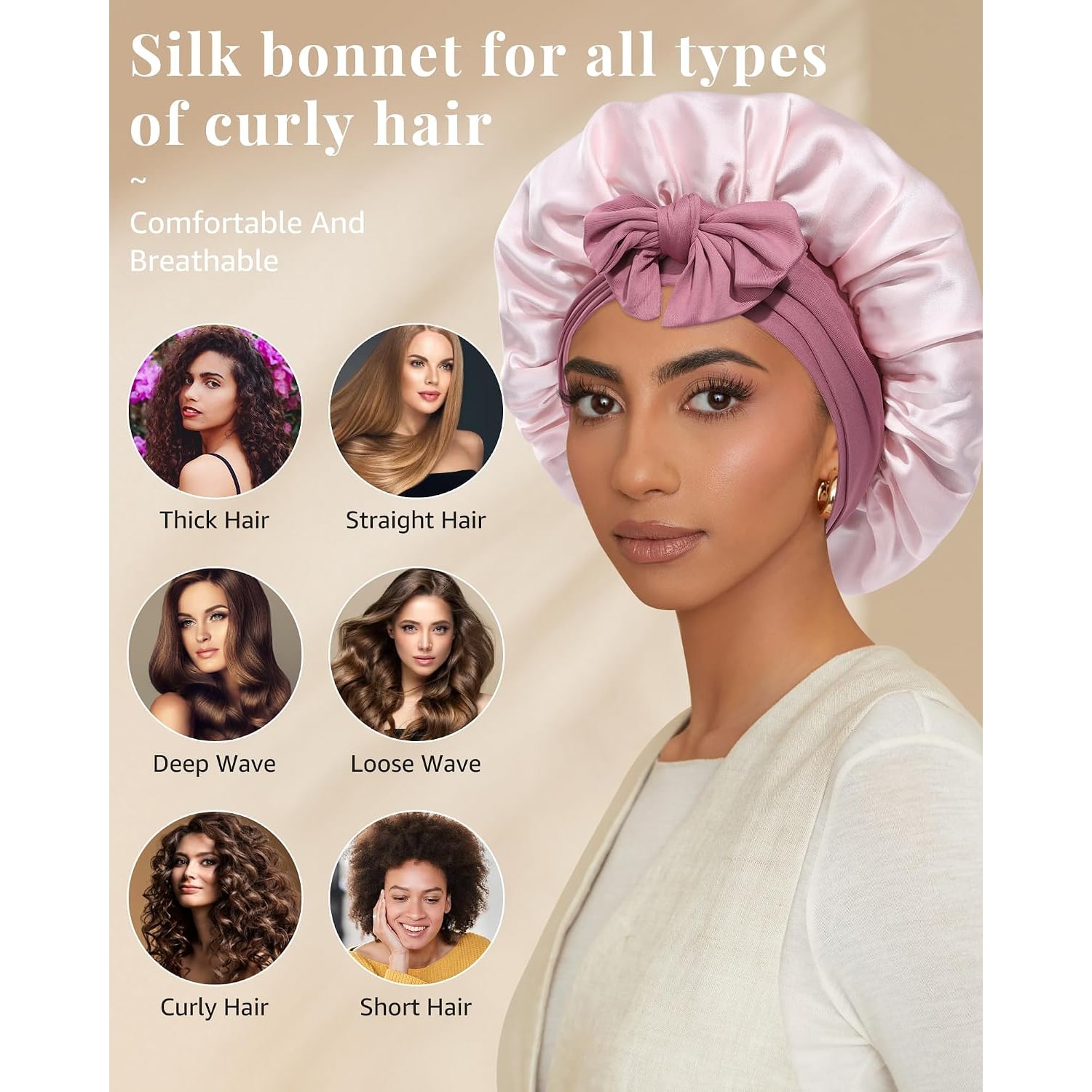
The exterior measures 13.8 inches, or 35 cm. That is roomy. It is meant to handle curls from 1a through 3c, mid-length 4a hair, and blowouts or roller sets you want to protect.
Volume is where small bonnets fail. If the cap is tight across the crown, it flattens everything underneath and you end up with a dent instead of a shape. A wide body lets the hair sit where it naturally wants to sit. That is the real reason people hunting for the best large silk sleep cap keep coming back to the measurement first and the look second.
There are limits. Very long box braids, waist-length twists or exceptionally dense 4c hair may need something larger, or a bonnet plus a scarf. The honest test is to put your hair in whatever bundle you normally sleep in and measure across it. If it fits comfortably inside 13.8 inches with a little slack, you are fine.
How to choose between the options out there
A few things separate a bonnet you will use nightly from one that ends up in a drawer.
Start with the fiber. Satin and silk are not the same thing. Satin describes a weave and is often made from polyester, which is smooth but traps heat and moisture against the scalp. Mulberry silk is a natural protein fiber that breathes and manages humidity better. The price gap is real, and so is the difference in how it feels on a warm night.
Then check the momme weight. If a listing does not state it, that usually tells you something. Anything under about 16 momme will feel thin and will not last as long through regular washing.
Look at the closure next. Adjustable ties beat fixed elastic for comfort, particularly if you have had headaches from caps before. And finally, consider the lining. Some bonnets are silk on the outside and polyester inside, which defeats the point entirely. The surface touching your hair is the surface that matters.
Color is the easy part, but worth a moment. Dusty rose is a muted, warm pink rather than a bright one. It does not look like a novelty item, which makes it easier to wear outside the bedroom and easier to give as a gift.
Washing it without ruining it
Silk is more forgiving than its reputation suggests, but it does not like three things: heat, bleach and aggressive twisting.
Hand wash in cold water with a mild detergent formulated for silk or a gentle wool wash. Swirl it for a minute, do not scrub. Rinse until the water runs clear, then lay the cap in a clean towel, roll it, and press. Never wring it out like a dishcloth, since that is what stretches and dulls the fibers.
Air dry it flat or on a hanger, away from direct sun and well clear of radiators. It dries quickly because there is not much fabric. If creases appear from storage, hang it in a steamy bathroom or press it with an iron on the lowest silk setting, working on the inside of the fabric.
How often? Every one to two weeks suits most people. If you use heavy oils, butters or overnight scalp treatments, wash more often, since those build up on the silk and eventually make it feel coated. Treated this way, a good 19 momme cap stays soft for years rather than months.
Living with it, realistically
The first two or three nights feel strange. Everybody says this. Your head is used to being bare and a bonnet registers as new information. By about night four, most people stop noticing it.
A few small habits help. Tie it slightly looser than feels secure at first, then tighten over a few nights until you find your setting. Put your hair up in a loose pineapple or a soft bun before you wrap, rather than leaving it loose, so it is not pushed forward over your face. And keep the cap somewhere obvious, like on the nightstand, because the main reason people quit is simply forgetting.
It travels well too. The whole thing packs into a space smaller than a paperback and weighs under half a pound with packaging, which makes it one of the easier things to throw into a suitcase.
The short version
A silk bonnet is friction management. Hair slides over a smooth 19 momme mulberry silk surface instead of catching on cotton, night after night, and the effect adds up.
This one gets the two practical details right. The tie band means no elastic digging into your ear, which matters most if you sleep on your side. The 13.8 inch body means your curls, coils or blowout are not crushed flat by morning.
Care is cold water, gentle detergent and air drying. Do that and it stays soft. The dusty rose shade is muted enough that you can keep it on past breakfast, which, judging by how most people use them, you probably will.